

Why a two-month delay vaccinating our penguins?
Why has it taken so long to start vaccinating Phillip Island’s world-famous but critically at-risk penguin colony?


WHY has it taken so long to start vaccinating Phillip Island’s world-famous but critically at-risk penguin colony?
On July 2, 2026, the New Zealand Department of Conservation announced it had completed “a world-first research trial on five native bird species that showed vaccination is safe and effective in these birds” and would start vaccinating them immediately.
Why not here?
The H5N1 strain of bird flu had not even arrived in New Zealand at that stage, but they were up and running.
The first case of H5 bird flu was detected in Australia, in a Brown Skua at Cape Le Grand National Park in Western Australia on June 19, 2026.
It wasn’t until July 30, 2026, that the arrival of the first case of H5 bird flu in Victoria was announced.
So, why has it taken two months, two full months to get a vaccination program rolling for the 40,000 strong Summerland Peninsula penguin colony when the Sentinel-Times was told in mid-July that Phillip Island Nature Parks was trialling a suitable penguin vaccine?
And why announce you are only vaccinating 5000 little penguins, and not all of them on Phillip Island. That includes the stragglers that come up on the beach at St Kilda.
Victoria's chief veterinary officer, Graeme Cooke, offered a clue on the delay when he spoke to the media on Saturday, August 15 after an announcement earlier in the day that a Phillip Island penguin had died from bird flu.
"We are rolling out the vaccination program as quickly and urgently as was possible after the federal authorities released the permits and released the vaccines to the jurisdictions," Dr Cooke said.
So, has it been federal authorities which have delayed the roll out of the vaccine? Who didn't tick the box "urgently" enough?
We’re talking about a $200 million-a-year tourism industry here, not to mention that the beloved little penguins are part of the Victorian ethos.
What took them so long?
Bird flu (H5N1) was first detected in Australia on June 19, 2026 in Western Australia but it was inevitable it would come this way.
The New Zealanders aren’t just vaccinating wild birds in captivity, they are also rolling out a program to vaccinate kākāpō and takahē birds on offshore islands. How much harder to take that on than round up groups of little penguins that are already arriving back at the same burrows most nights?
Here’s what the New Zealand authorities had to say:
DOC is working with the Ministry for Primary Industries (MPI), the Ministry of Health and Health New Zealand | Te Whatu Ora as part of a One Health approach to prepare for the possible arrival of H5N1 in New Zealand.
Last year DOC completed a world-first research trial on five native bird species that showed vaccination is safe and effective in these birds and will help protect them from bird flu.
Vaccination will begin with these five birds – kākāpō, takahē, tchūriwat’/tūturuatu/shore plover, kakī/black stilt and kakariki karaka/orange-fronted parakeet.
About 300 core breeding birds from the five species will be vaccinated. These birds are in captivity or, in the case of kākāpō and takahē, on offshore islands.
DOC Senior Science Advisor and wildlife vet, Dr Kate McInnes, says these species were chosen because they have small populations that could be at risk and are reliant on intensive conservation efforts for their ongoing survival.
“We’re in a unique position to be able to vaccinate some of our most vulnerable birds as a precaution before H5N1 bird flu potentially arrives here.
“We’ve seen the devastating impacts of this virus on wildlife in other parts of the world, and we want to reduce the risk to our precious native birds where we can.
“It won’t be possible to vaccinate all endangered birds if bird flu arrives, but we can focus on those species where the full two doses of the vaccine can be safely given to achieve protection.”
Kate McInnes says over the past four years DOC has been researching and drawing on overseas evidence and experience to develop a vaccination plan for the New Zealand situation.
A team of DOC vets and specially trained staff will administer the vaccine, supported by species rangers and facilities staff. The work will start this month to avoid the breeding season and give birds time to develop full immunity before spring.
Do you note that statement: “…give birds time to develop full immunity before spring”.
How long will it take the little penguins to develop immunity, especially given they need two doses?
These questions and more can be asked at a community meeting in the Berninneit Cultural Centre in Cowes, at 4pm on Friday, August 21, where, we are told, all key agencies, including DEECA, PINP, BCSC and emergency management groups, will have technically qualified people on hand to provide accurate, up-to-the-minute details.
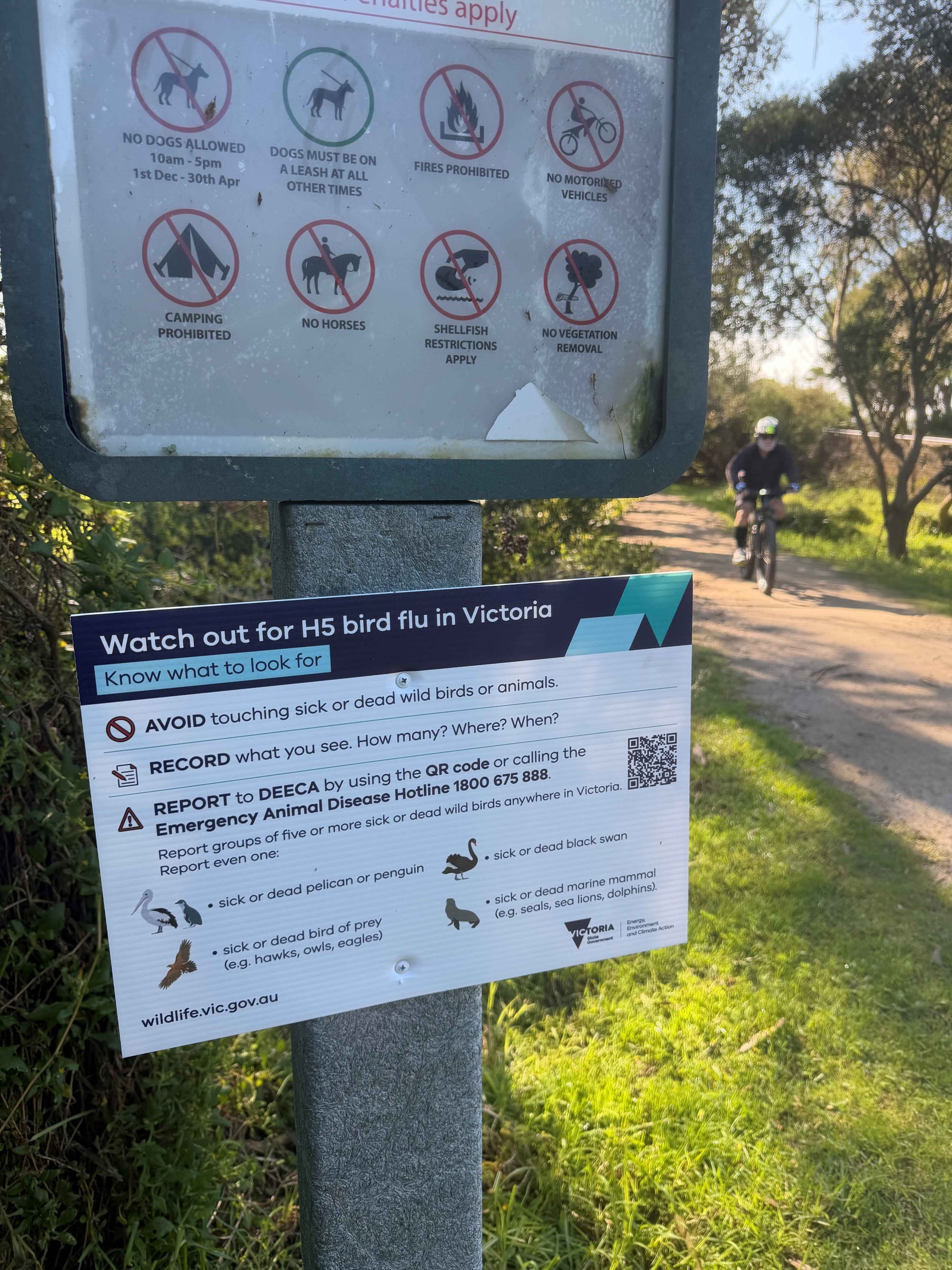
A short history of H5N1
Influenza A/H5N1 was first detected in 1959 after an outbreak of highly pathogenic avian influenza in Scotland, which infected two flocks of chickens.
The next detection, and the earliest infection of humans by H5N1, started with an epidemic in nonhumans in Hong Kong's poultry population in 1997. This outbreak was stopped by the killing of the entire domestic poultry population within the territory.
Human infection was confirmed in 18 individuals who had been in close contact with poultry, 6 of whom died.
Since then, avian A/H5N1 bird flu has become widespread in wild birds worldwide, with numerous outbreaks among both domestic and wild birds. An estimated half a billion farmed birds have been slaughtered in efforts to contain the virus.
It was inevitable it would arrive in Australia.
Cattle: The H5N1 avian flu variant was first identified in cattle in America in March 25, 2024. Since then, the variant has been identified in 845 individual cases across 16 states as of early December 2024.
According to the American Veterinary Medical Association common clinical signs of H5N1 infection in dairy cattle include symptoms such as a reduced appetite, lower milk production, and abnormal milk appearance.
While lactating cows are the most affected, typically it is reported in less than 10% of a herd, with a low mortality or culling rate of 2% or less.
The commercial milk supply has not been affected, as milk from H5N1-affected animals is almost always diverted or destroyed before entering the food supply, and then as milk goes through pasteurization, the virus becomes effectively inactivated. Testing of retail dairy products, including milk, butter, cheese, and ice cream, has found no live, infectious H5N1 virus which further supports the US Food and Drug Administration's position that pasteurized milk is safe for consumption.


