

Floating wetlands slash Phillip Island emissions
A floating wetland trial on Phillip Island has cut greenhouse gas emissions from wastewater treatment by more than a quarter, offering a potential low-cost solution for the water sector.


A floating wetland trial on Phillip Island has cut greenhouse gas emissions from wastewater treatment by more than a quarter, offering a potential low-cost solution for the water sector.
The trial went for two years and was led by RMIT University in partnership with Westernport Water and CSIRO.
The objective of the trial was to test whether native plants could reduce emissions from an operational wastewater lagoon.
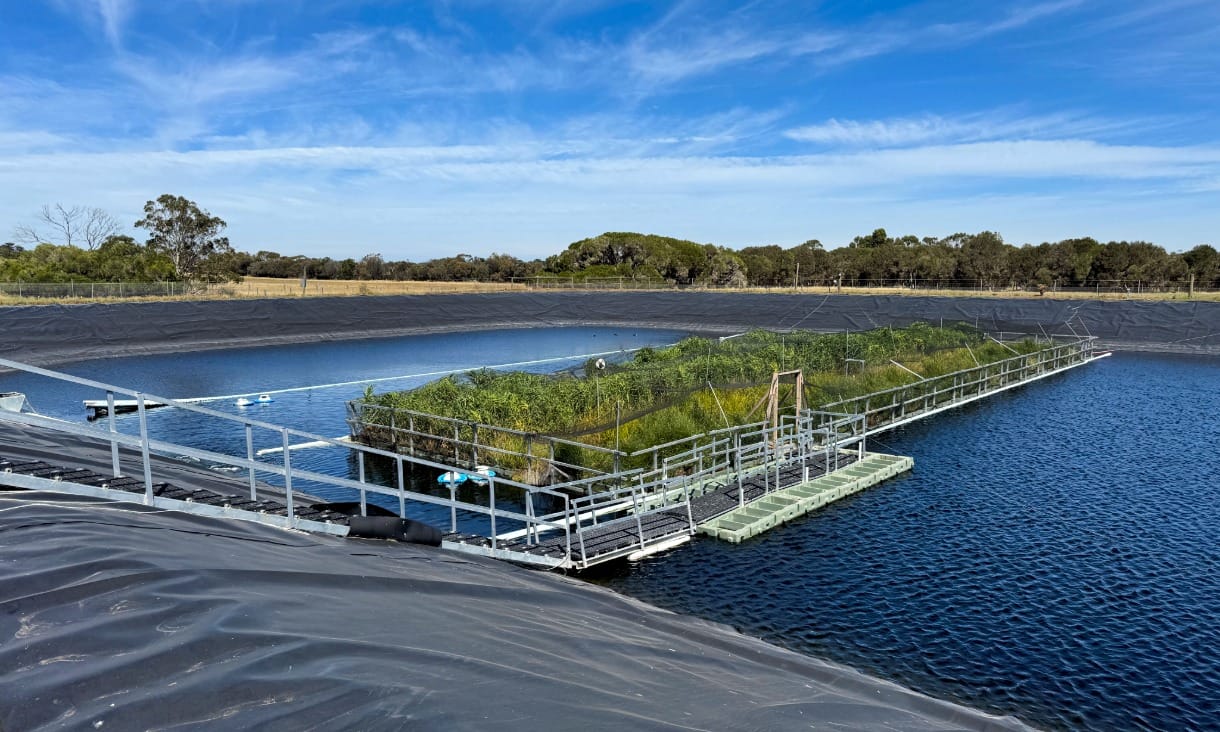
A 330-square-metre floating platform, which is roughly one-and-a-half tennis courts, planted with native reeds and sedges was installed by researchers.
Its performance was compared with a lagoon without a wetland platform.
Results published in the ‘Journal of Environmental Management’ found carbon dioxide emissions fell by up to 36 per cent and methane by up to 66 per cent, while nitrogen emissions were also reduced by 18 per cent.
RMIT University researcher Dr Lukas Schuster said floating wetlands were already used in some wastewater systems to reduce nutrient loads, but their emissions-reduction potential had not previously been demonstrated at full operational scale.
“This is the first time we’ve had evidence on this scale that supporting microbial communities in the root systems of wetland plants can reduce wastewater emissions without relying on high-tech solutions,” Dr Schuster said.
“It’s a strong demonstration of how nature-based approaches can transform wastewater treatment into part of the climate solution.”
With this system, the plants’ roots hang beneath the floating platforms, creating habitats for microbes that consume nutrients, pollutants and greenhouse gases, with reductions becoming apparent roughly four months into the trial.
Emissions from both lagoons were continuously monitored using ‘Pondi’, a solar-powered sensor developed by RMIT alongside several research and engineering partners.
Westernport Water Managing Director Dona Tantirimudalige said the floating wetlands could be retrofitted into existing lagoons without requiring major infrastructure changes.
“The outcomes provide a strong foundation for further work to test performance across additional lagoon types and operating conditions,” she said.
The research has also expanded beyond wastewater treatment, with floating wetlands now being trialled in farm dams all across Bass Coast through a partnership involving RMIT, Melbourne Water and the Bass Coast Landcare Network.
That project will examine the floating wetlands’ effects on emissions, water quality and biodiversity in the dams.
If successful, many researchers believe the technology could improve the health and productivity of farm dams across Australia, while also providing another practical way to reduce emissions.


