

The virtual fencing collars changing local farms
A MIRBOO North farmer says he’s already seeing improvements to the way he manages cattle, less than a month after introducing virtual livestock collars.


A Mirboo North farmer says he’s already seeing improvements to the way he manages cattle, less than a month after introducing virtual livestock collars on his property.
Will Lawrey and Sarah Prime, who have cattle on two properties, one in Mirboo North and the other in Mount Eccles, were among the first farmers in Victoria to sign up for the eShepherd virtual fencing system after regulatory changes recently allowed the technology to be used for cattle.
The GPS-enabled collars allow farmers to draw virtual fence lines on the property through an app, and when cattle approach the virtual boundary, the collars emit an audio cue. If the animal continues to move past the set boundary, it receives a mild pulse.
Mr Lawrey, who has a full-time job in addition to his farm, said 13 cattle were now wearing the collars on the couple’s 40-acre Mirboo North Property, with plans to fit the bull soon.
He said it only took a few days for the cattle to adjust.
“It probably took the cows three or four days to get used to the training, to get used to the audio cues and the pulses,” Mr Lawrey said.
“Now I can do it all from work, pretty much.”
The training process began in a paddock with permanent fencing on three sides, and a virtual boundary drawn across the fourth side.
Mr Lawrey said the cattle crossed the virtual line at first but quickly learned to respond to the sound cue alone and return to their mob.
“It didn’t take very long at all before all of the cows were following just the sound cues,” he said.
The collars were originally purchased with the couple’s Mount Eccles property in mind, although they are currently being used at their Mirboo North property while Mr Lawrey makes some modifications to the older yards at Mount Eccles.
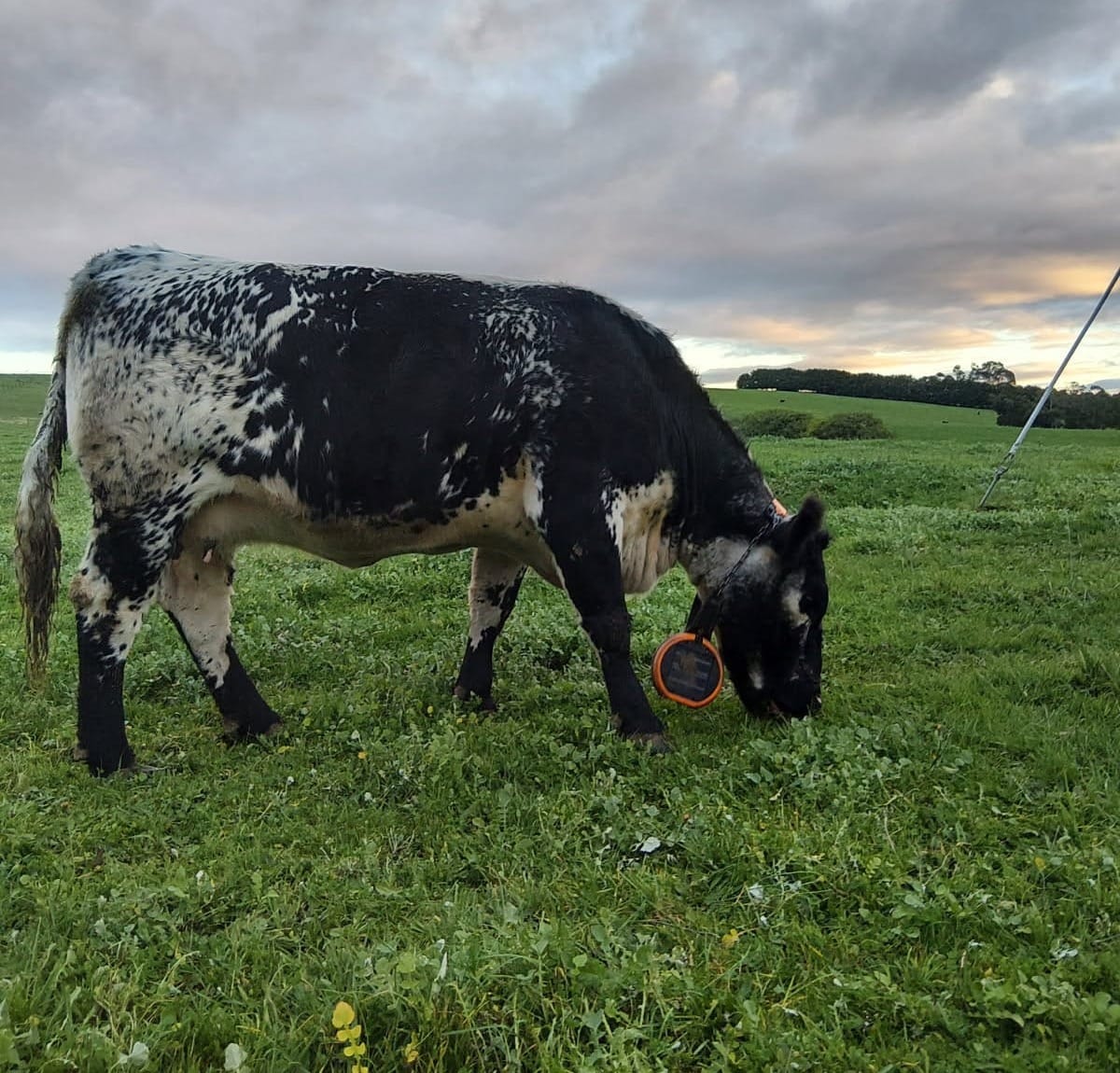
He said the benefits are already showing, especially when it comes to rotational grazing and pasture management.
On one steep section of the Mirboo North farm, Mr Lawrey recently used the app to exclude cattle from the lower part of a hill, allowing grass to recover in an area that would otherwise be extremely difficult to fence.
“To fence that would be a nightmare,” he said.
“I walked the paddock and marked right where the hill drops away, and drew my virtual boundary along that contour.
“I’ve been able to give that bottom of the paddock an extra rotation to grow some grass.”
The new virtual system has also allowed Mr Lawrey to create smaller grazing areas around existing troughs, with cattle being moved through what he called “wedges” over set time periods.
He said the technology had reduced the amount of time he spends shifting electric fencing after work, especially during winter.
“What is a 10- or 15-minute job now could have been a one or two-hour job before,” he said.
However, Mr Lawrey said the collars would not replace hands-on animal checks.
At Mount Eccles, he currently visits three times a week.
“It will never get rid of physically inspecting the cattle,” he said.
“You’ve got to get up and inspect them.”


