Bass Coast Shire presses panic button on Silverleaves’ work
The cash-strapped Bass Coast Shire Council is showing signs it is ready to press the panic button when it comes to paying for beach erosion. But will it leave the residents of affected coastal towns facing an uncertain future as well as angry seas?


THE cash-strapped Bass Coast Shire Council is showing signs it is ready to press the panic button when it comes to paying for beach erosion.
But it’s a change of heart that could catch the hapless residents of Phillip Island’s Silverleaves in an unenviable position.
At the October 7, 2026, meeting of council, where its Annual Financial Report and Performance Statement 2025-2026 was released for consultation, council blamed, in part, the “unbudgeted funding of coastal erosion programs”, to the tune of $470,000, for a $14.2 million blowout in its expenditure.
This led, again in part, to it reporting an underlying deficit of $19.2 million and with more coastal erosion expenditure coming home to roost this financial year, council has seen red.
At that meeting, Cr Jon Temby warned council would increasingly be unable to meet community expectations around coastal property protection.
“I note that funding for coastal erosion projects and inundation is commendable in one sense, but creates a false expectation, a sense of entitlement and precedent that cannot be funded at local, state, or federal levels,” said Cr Temby.
“As the risk of inundation and other climate change-related risks increases, you need to take this on board, the council's finances and ability to meet community expectations are very constrained by our cap rates and increasingly poor financial support from state and federal governments.”
His colleague, Cr Tim O’Brien is following up at this Wednesday’s council meeting with a Notice of Motion calling for an immediate briefing from DEECA and their consultants on the final scope and design of major Silverleaves' coastal work set to be released by the department by the end of October.
While the emphasis of Cr O’Brien’s motion is around the sustainability of the works so far outlined in options’ statements, including the introduction of an artificial reef or rock sill to support a littoral vegetation project (in the intertidal zone), he also raises the concern that council might have to pick up the tab if such initiatives fail.
According to the agenda for this Wednesday’s council meeting, Cr O’Brien intends to move the following motion: “That Council seek an immediate briefing from DEECA and their consultant team regarding the proposed works at Silverleaves, addressing the following issues and community concerns:
- The cost of the proposed offshore reef and its impact on visual amenity at Silverleaves (including its location and visibility between tides);
- The potential hazard of this artificial reef to boating, sailing and other activities;
- A direct comparison between the cost of installation of additional groynes as opposed to the cost of the offshore reef;
- The cost of removal should the structure of the offshore reef fail, whether it is indeed possible that the offshore reef could fail, and/or should it not perform as expected in providing protection to the shoreline;
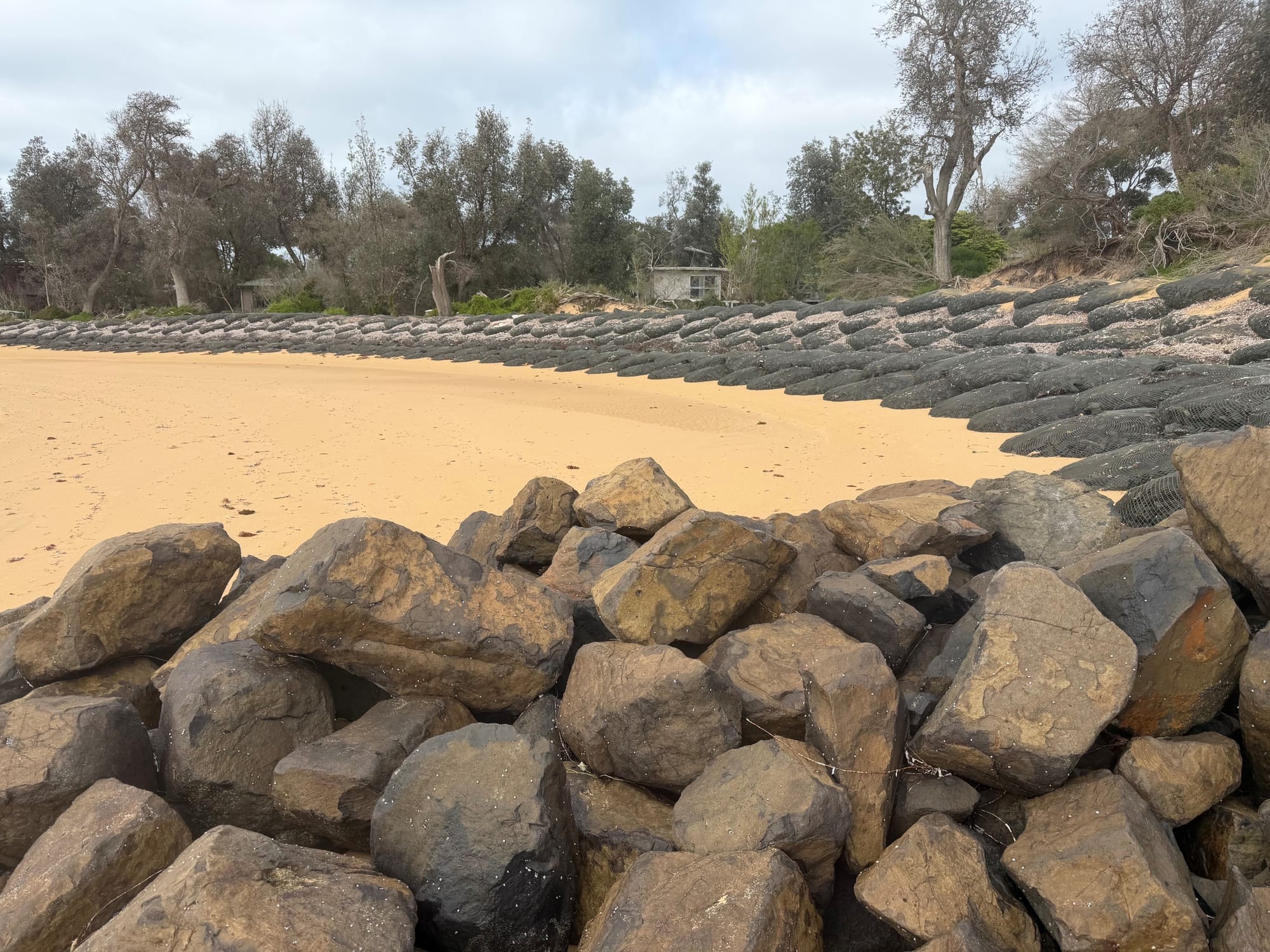
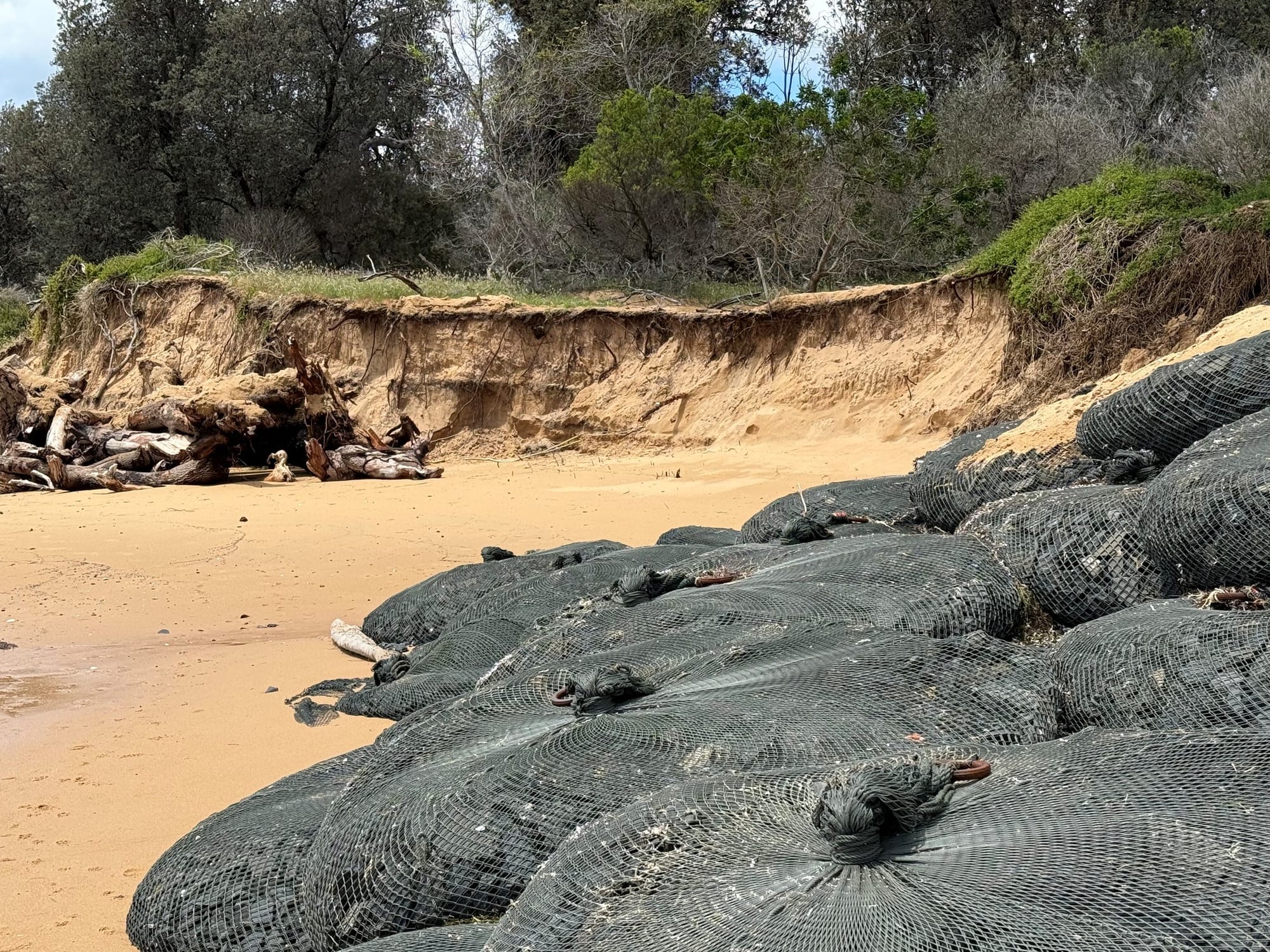
- An investigation into future management of Silverleaves foreshore, this to include an examination of the effectiveness of existing groynes, of the sand at depth where existing groynes are maintained in good condition, and of the potential benefits for continuation of groynes along with the planned extension of the rock-bag wall (along the shoreline abutting Woodland/Silverleaves Ave); and,
- That this briefing include a report to be tabled at the December 9, 2026 Council Meeting and provided to the community of Silverleaves to ensure it is kept fully informed of the impacts, costs and benefits of the proposed foreshore management.
While Cr O’Brien has consulted widely with residents of Silverleaves and its community groups, including the Cowes East Foreshore Preventative Action Group, it’s unlikely that he’s introduced his Notice of Motion in isolation of the shire’s financially pressed administration.
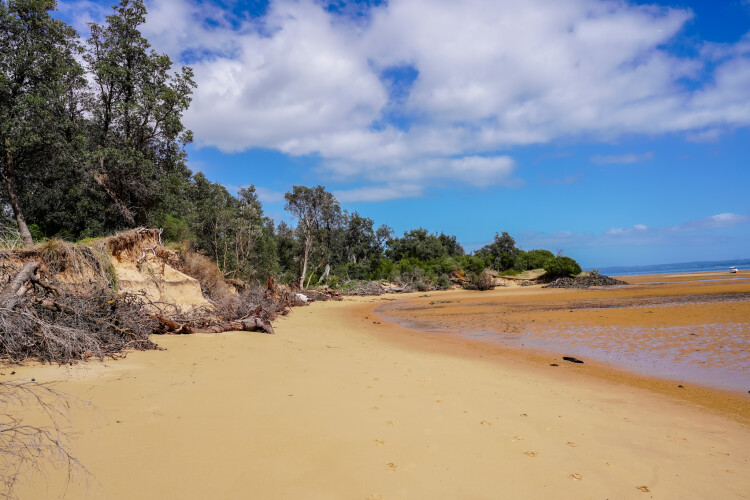
In his explanation for the motion, Cr O’Brien notes not only the climate-driven storm activity which has threatened the coastal strip east of Cowes, but also that some of the remedial works to date have actually made things worse.
“Residents there on the frontline, whose properties are also threatened, are well aware of these threats. For most, those who have watched and counted each banksia fall and who have spent decades observing both gradual and dramatic changes to that shoreline, it is clear to their eyes which interventions have worked, which have had little impact, and which have made the situation worse.
“Silverleaves beach, this magical place that glows in the mornings and evenings with the titanium shimmer of banksias framing magnificent golden sands, is one of the jewels of Phillip Island.
“We must be sure as Council and as residents that works there to protect it are sustainable, are in keeping with its status as “a unique beautiful place to be protected”, and do not replace one problem with another.
“With a report imminent on the future of Silverleaves beach and of works there proposing a dramatic and not-easily reversed off-shore artificial reef, one that potentially could alter forever the amenity and beauty of the beach, shoreline and north-facing water views, we, as Council, the residents we represent, and those that follow us, must be sure of what we’re figuratively “signing up for” with the works in prospect.
He said the residents he had spoken to all expressed concerns about the proposed works and also that “such works may not be adequately supported by funding in the event the artificial reef fails structurally, or simply doesn’t work, and needs to be removed. What will it cost to remove it?” he asks.
“An extension of the rock-bag wall is also proposed. With this work, Council and the community also seeks confirmation that consideration is given to the effectiveness and cost of installation of additional groynes to run the length of Silverleaves, against the projected cost of the proposed off-shore artificial reef.
“Many residents point to the groynes, some in good condition, some poor, running from Erehwon Point, to near the end of the previously installed rock revetment, as carrying evidence of the effectiveness of groynes in disrupting wave action to retain sand and in protecting the shoreline generally.”
Should this motion be approved, shire officers will contact DEECA to arrange the briefing as requested, and prepare a report for the December 2026 council meeting.
A spokesperson for the Cowes East Foreshore group, Ken Hailey, welcomed Cr O’Brien’s comments but also noted that relative inaction on the erosion problem at Silverleaves, since destructive storms in 2023, had led to further loss of coastline, destruction of vegetation, increased threat to homeowners and worryingly, a contraction in viable options.
“Because it has been let go, and let go, for what will be four years by the time works scheduled for April next year start, it’s a mess,” said Mr Hailey.
“Council is also worried that the $2.8 million in funding they’ve been granted by State and Federal governments won’t be enough, that they’ll have to pay the rest for the works and for any on-going problems.
“Cr Temby has already flagged that.
“There’s a range of views about what should happen, and I’ve got mine too, including questions about where this reef idea, or rock sill, has been tried before, but it’s taking so long that they’ll end up with only limited options for protecting houses and infrastructure.”
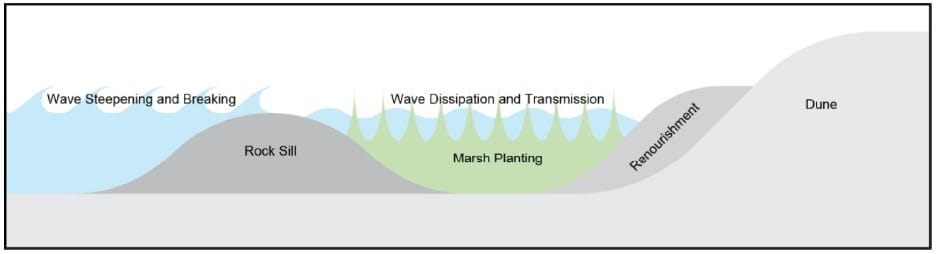
Shortlisted options
Shortlisted actions include dune reconstruction, groynes, supported littoral vegetation, living seawall, shaped rock or block wall, revetment (sloping rock wall), vertical rock wall, near-shore breakwater.
The ‘Littoral vegetation’ option is a nature-based hybrid approach involves establishing native shoreline plants, supported by low-profile rock sills, shellfish reef or rock berms. In this case, these structures would protect the plants and reduce shoreline erosion by absorbing wave energy and guiding tidal currents along the shore, mitigating erosive flow patterns. Beach nourishment is usually also undertaken to create beach amenity and access as well as space for the vegetation to migrate with future sea levels.
See also the ‘East Cowes and Silverleaves Adaptation Plan’ produced by Range Consulting Pty Ltd in October 2025 for the Victorian Department of Environment Energy and Climate Action HERE