

‘I Was Only 17’ Vietnam Veterans mark 60th anniversary of the Battle of Long Tan
‘I Was Only 17’ South Gippsland Vietnam Veterans at the Leongatha Cenotaph on Vietnam Veterans' Day to mark the historic 60th anniversary of the Battle of Long Tan recall leaving home as teenagers to fight a war that would define a generation.


NOTHING could be more poignant than hearing a Vietnam Veteran tell you how he was just 17 when he left home to fight a war that would over time define a generation.
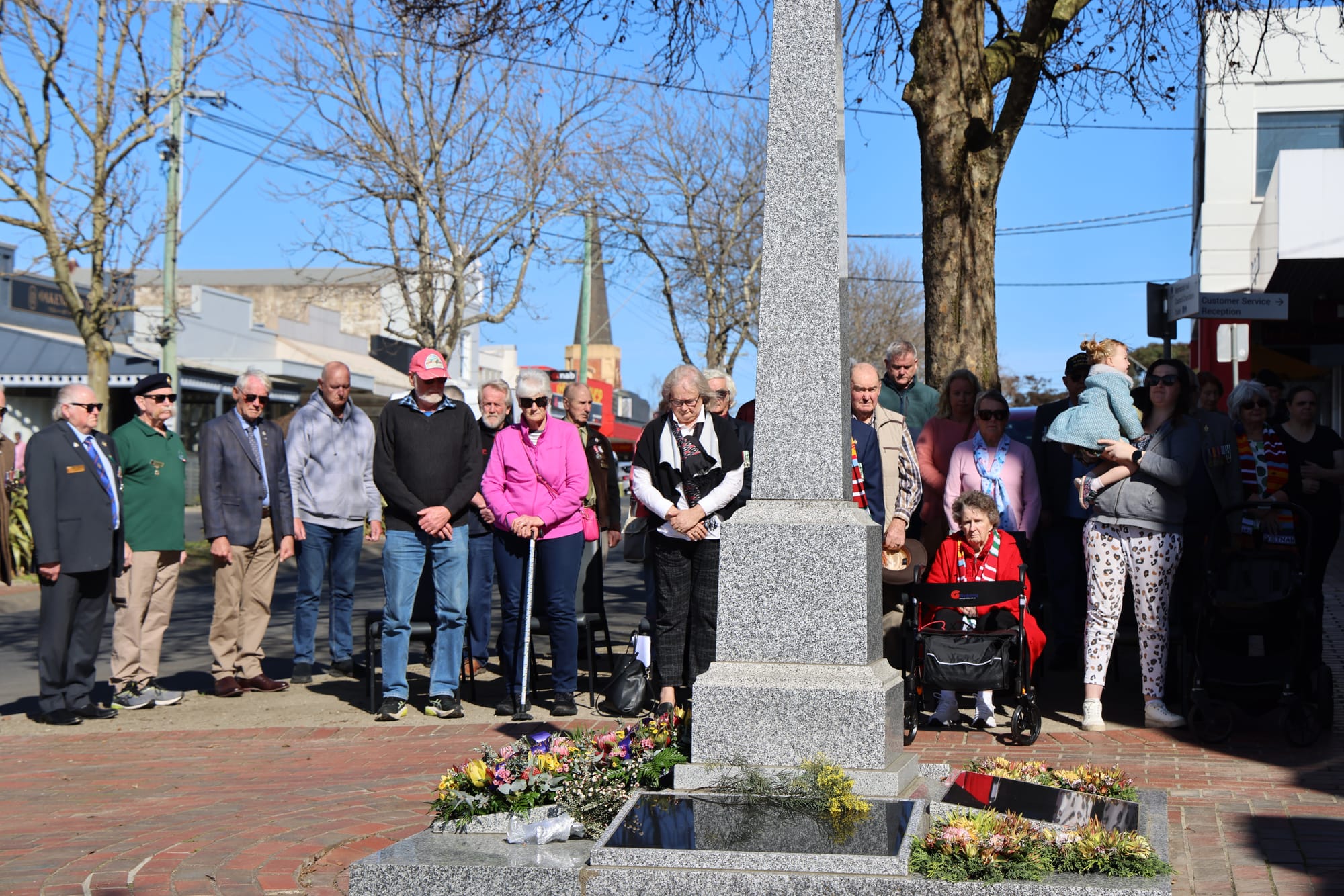
A sombre crowd gathered at the Leongatha Cenotaph on Vietnam Veterans' Day to mark the historic 60th anniversary of the Battle of Long Tan.
Delta Company patrolled out alone from Nui Dat on the morning of 18 August to relieve Bravo Company. Alpha Company was still at the Nui Dat base when the battle started at 1525 hours. Alpha Company arrived via Armoured Personnel Carriers (APCs) as a relief force at approximately 1855 hours to save Delta Company from being overrun.
Among those deployed in the area was volunteer serviceman Rifleman Vince Campisi, who served with Alpha Company, 6 RAR. At 1300 hours on that fateful day, Delta Company met up with Bravo Company who had been patrolling since the previous afternoon.
Alpha Company and Delta Company continued their fateful advance towards the dense rubber plantation of Long Tan. At 1525 hours, the first shots rang out, piercing the afternoon air and triggering one of the most savage engagements in Australian military history.
“We went in and it was hell,” recalled Campisi his voice heavy with emotion.
“The reality was every single one of us, feared the bullet, it just won’t go away.”
National Serviceman Dick Lester said milestone dates like Vietnam Veterans' Day and ANZAC Day frequently trigger the horrors of that conflict for surviving veterans.
In the space of just three and a half hours, Delta Company survived a ferocious onslaught by an enemy force of between 1,500 and 2,500 soldiers from the Viet Cong 275th Regiment and D445 Battalion.
They fought in blinding, muddy conditions during a heavy tropical downpour.
Though desperately outnumbered, the Australians held their ground. They were resupplied from the air by helicopter crews, supported by a relentless artillery barrage that fired 3,500 rounds, and eventually reinforced by Armoured Personnel Carriers.
Australian casualties at the Battle of Long Tan were 18 killed in action (17 from Delta Company and 1 from the 3 Troop, 1 APC Squadron) and 24 wounded. Sixty years on, the annual gathering at Leongatha ensures that the courage, sacrifice, and enduring trauma of those young soldiers, many just teenagers, will never be forgotten.
The Vietnam War remains Australia’s longest military engagement of the 20th century, spanning a decade of intense conflict from 1962 to 1972. During this period, nearly 60,000 Australian personnel were deployed to the region.
The majority of service members were regular permanent force volunteers complemented by conscripted national servicemen. The human cost of the war was severe, resulting in 521 Australian deaths and nearly 3,000 wounded.
On Vietnam Veterans Day the Returned and Services League (RSL) commemorates the vast scope of this service. Tributes honour every level of engagement, from major operations down to company, platoon, and section-level encounters.
The commemoration recognises the Royal Australian Navy sailors who supported operations, the Royal Australian Air Force personnel who served in combat and transport roles, and New Zealand veterans (Kiwis) who served alongside them.
It also honours the civilian doctors and nurses who provided vital medical support.
Frontline infantry units faced intense combat environments. The 1st Battalion, Royal Australian Regiment (1 RAR) served from June 1965 to June 1966. Initially attached to the United States 173rd Airborne Brigade and later the 1st Australian Task Force, 1 RAR operated primarily in Bien Hoa and Phuoc Tuy provinces, taking a notable role in Operation Crimp in early 1966.
The 6th Battalion (6 RAR) arrived in June 1966 to relieve 1 RAR. During this first tour, which lasted until May 1967, 6 RAR fought the Battle of Long Tan on August 18, 1966.
Behind the front lines, critical communication infrastructure kept the military connected. During 1969 and 1970, the 110 Signal Squadron operated across multiple fixed locations, including Saigon, Long Binh, Vung Tau, VC Hill, and Nui Dat.
This unit managed record-high message volumes through the Saigon Major Relay Station. They also handled massive telephone traffic via the EMU switchboard in Vung Tau, which peaked at 7,000 calls per day in April 1970.
The squadron constantly battled severe network strain, addressing circuit saturation and infrastructure pressures linking Vietnam to Australia. Simultaneously, they maintained fixed signal centres and supported temporary AN/MRC-69 radio relay terminal deployments to tactical fire support bases.
Ultimately, the legacy of the Vietnam War is defined by both the fierce tactical battles of the infantry and the relentless technical support of logistical units. Vietnam Veterans Day ensures that the combined sacrifices of all our military branches, allied partners, and medical volunteers continue to be remembered.


