A quiet global revolution hidden in Newhaven
Phillip Island charity Free 3D Hands opens its Newhaven design centre this Friday with tours of the printing floor and the story of how founder Mat Bowtell went from Toyota engineer to sending assistive devices to 59 countries.


ON Friday morning, a 3D-printed arm left a small factory on Boys Home Road, Newhaven, bound for Guatemala.
It was just another day for Mat Bowtell and Free 3D Hands, the Phillip Island charity that has sent assistive devices to 59 countries.
Every one is designed, printed and posted out for free.
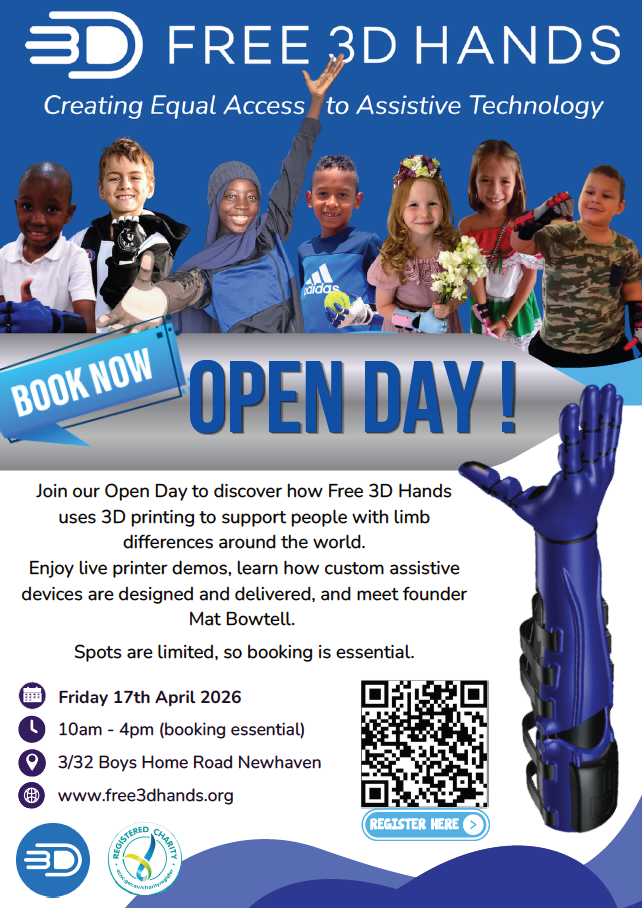
This Friday, the public gets a rare chance to see how it happens, when the Newhaven design centre throws open its doors.
Visitors will get tours of the printing floor, a walk through the design lab and the full story of how a guy who lost his job at Toyota built something extraordinary.
Last year the inventor of 3D printing himself, American engineer Chuck Hull, flew out from California to see it.
"To bring him into our world and show him what we're doing with his invention was pretty special," Mat said.
It started with one hand, for one kid, back in 2014 when Toyota announced it would close its Australian plant within three years.
Mat, a senior engineer at the plant, was offered jobs setting up Tesla's production lines but turned them down to stay on Phillip Island with his young family.
"I grew up on Phillip Island and decided South Gippsland was the best place to raise them," he said.
"It started with one hand for one kid, and when I saw the smile on his face, it changed my life."
Two weeks after walking out of Toyota for the last time, Mat was named one of the Victorian Australians of the Year.
Love Your Sister founder Samuel Johnson then took him under his wing.
"Right when I lost my job, I had people in my corner telling me to keep going," Mat said.
Nearly 10 years on, Free 3D Hands has a waitlist, with applications coming in constantly and the charity's in-house manufacturing stretched to its limits.
The focus has shifted away from how many devices the Newhaven team can make and towards helping others replicate the work in their own countries.
Mat estimates around 27,000 people globally are now producing his designs under an open-source licence.
He spent six months during COVID writing a 100-page assembly manual so others could do exactly what Free 3D Hands does.
"All of our IP and all of our designs, we open source and share with communities around the world," he said.
"There are groups in Colombia, right through Europe in Italy and France, through the United States, and in all corners of the globe."
The most striking proof of that reach came last year, when Mat read the news online.
"A guy in Canada downloaded our arm design, made it, and sent it to Sicily," he said.
"He put it on a boat, and Greta Thunberg took it on the Freedom Flotilla to try and get it into Gaza as a symbol of the need for assistive technology there."
Most Free 3D Hands devices are body-powered, using a functioning wrist or elbow to close the fingers of the hand.
Recipients can pick up a cup, catch a tennis ball or hold a bicycle handle, all from a device that costs a fraction of commercial alternatives.
The charity has just released version two of its kinetic arm and is developing version two of the kinetic hand, which first came out in 2020.
Designs are constantly refined based on feedback from recipients themselves.
"A lot of the recipients we made first hands for when they were three years old are now teenagers," Mat said.
"We are continuously making them improved assistive devices as they grow."
The next frontier is a low-cost bionic arm, with university interns working on machine learning algorithms.
The algorithms load onto a microcontroller the size of a postage stamp that costs about $6.
"We've been able to make a functioning bionic arm for about $27 in components, where typically they would cost $40,000 to $60,000," Mat said.
"Our aim is to develop all of our designs for one-thousandth of the cost of a commercial alternative."
Mat said artificial intelligence had also become part of the process.
"We treat AI like ChatGPT not as a way to cut the number of people we require as a charity, but as an additional tool on our shelf," he said.
"A lot of what we work on hasn't been done before, so having AI as part of that brainstorming process makes you think in different ways."
Closer to home, Mat is quietly seeding the next generation.
Free 3D Hands has given away about 25 of its older 3D printers to local schools over the past year as the charity upgraded its own lines.
The team also regularly hosts work experience students, with kids from Bass Coast College and Newhaven College currently on board.
"We're really trying to get kids into STEM, or STEAM with the creative side," Mat said.
When COVID hit, the team pivoted overnight to produce free face shields for Bass Coast Health and frontline workers around Australia.
"If we had another year like that, the whole house of cards could fall down," Mat said.
For all the international reach, Free 3D Hands survives year to year on community donations.
Lions Clubs, Rotary Clubs, CWA, Inner Wheel, individual donors and Mat's public speaking fees all feed straight back into the charity.
"Larger charities rattle the tin to raise money for researchers," he said.
"In our case, we're innovating with one hand and rattling the tin with the other."
Mat will lead the tours himself on open day, with Island Organics next door running a barbecue supported by local businesses.
Spots are still available and bookings are essential via the QR code on the Free 3D Hands flyer.
For a man pioneering technology that commercial companies charge tens of thousands for, and sending it around the world for nothing, Mat remains genuinely surprised anyone in the region knows his operation exists at all.
"A lot of people don't even know that we're here," he said.
"We just work silently."