

Bird flu claims first Phillip Island penguin
Vaccination of the island's colony will begin on Monday evening after Victoria's first detection of H5 bird flu in a penguin.


A LITTLE penguin has died of H5 bird flu on Phillip Island in Victoria's first confirmed penguin case.
Vaccination of the island's colony will now begin on Monday evening, brought forward after the detection was confirmed.
The death was confirmed by the Department of Energy, Environment and Climate Action (DEECA) on Saturday, days after the State Government pledged thousands of vaccinations to protect Victoria's at-risk penguins.
It brings the total number of H5 cases in Victoria to 74.
The penguin was one of three new detections announced on Saturday, along with a crested tern at Lakes Entrance and a crested tern at Dromana on the Mornington Peninsula.
The Lakes Entrance case is the first confirmation of H5 bird flu in East Gippsland.
DEECA chief veterinary officer Dr Graeme Cooke said the penguin was found outside the Penguin Parade, in the wider Phillip Island area.
"Of course we are very concerned about this detection," Dr Cooke said.
The Penguin Parade remains open.
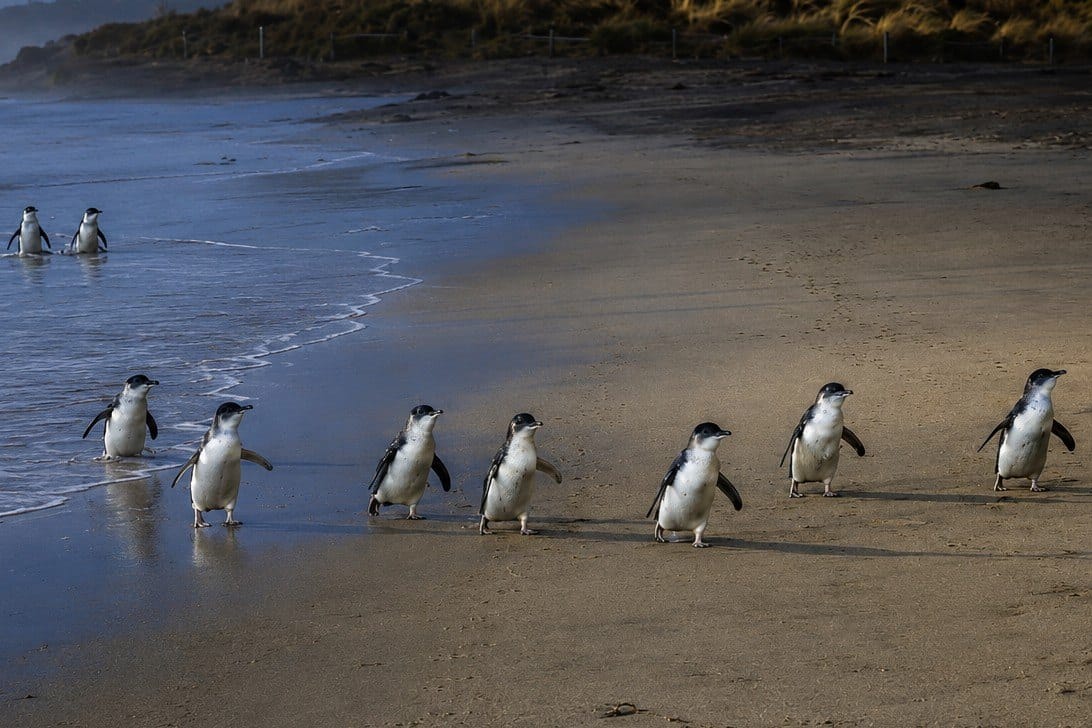
Vaccination of more than 5000 little penguins at Phillip Island and St Kilda was announced on Wednesday and had been expected to begin early next week.
Each penguin needs two shots for the vaccine to be effective and will then be microchipped and monitored.
The rollout is expected to take weeks.
Dr Cooke said Agriculture Victoria and Phillip Island Nature Parks activated the vaccination plan as soon as the Federal Government authorised the use of H5N1 vaccines for priority native bird species.
"While the first detection in a little penguin is a concern, vaccination of little penguins on Phillip Island remains a meaningful way to help protect this important colony," he said.
"Vaccination is not a guarantee against infection but remains an important tool that may help reduce the impact of H5 bird flu in this population.
"We will continue to monitor the colony closely and adapt our approach as new information becomes available."
Dr Cooke said the scale of the operation was unprecedented and he could not confirm whether it could be sped up further.
"It has never been done at this scale before, this would be an exercise ten times bigger than what has been attempted anywhere else in the world," he said.
"The Phillip Island Nature Park is working as quickly as possible and as soon as the federal authorities made (vaccinations) possible."
DEECA chief biodiversity officer James Todd said the Lakes Entrance detection showed the virus was continuing to move through wild bird populations across the state.
"The Gippsland Lakes are also habitat for large numbers of seabirds, shorebirds and waterbirds at higher risk from H5 bird flu, so spread of the virus through this area is likely to have significant impacts on wildlife," Mr Todd said.
He said the number of infected penguins could be higher than the single confirmed case.
"From overseas experience, we know that H5 can spread quickly through colonial nesting species," Mr Todd said.
"That's where our biggest concerns are now with respect to the recent cases at Lakes Entrance, the Mornington Peninsula and also Phillip Island.
"These represent areas where large numbers of species aggregate, particularly in spring for feeding and breeding, and it's really conducive to the virus breeding.
"The death of a little penguin is concerning, but we are proceeding with the vaccination program as quickly as possible, and it really makes that an even more urgent task to get on with.
"It'll be weeks in terms of the delivery of the program across Phillip Island and St Kilda."
No detections have been found in poultry or other animals, and free-range flocks across southern Victoria remain under a housing order as a precaution.
A community information meeting involving DEECA, Phillip Island Nature Parks, Bass Coast Shire Council and emergency management teams will be held at Berninneit in Cowes on Friday August 21 at 4pm.
People are asked to avoid touching sick or dead wildlife and to keep pets away from animals and carcasses.
Sightings should be reported through the Agriculture Victoria website or to the Emergency Animal Disease Hotline on 1800 675 888.


