Doomed French Island koalas a symptom of management failure statewide
IN THE absence of natural predators and disease, French’s Island koalas are killing themselves and the environment around them with their own success.


IN THE absence of natural predators and disease, French Island's koalas are killing themselves and the environment around them with their own success.
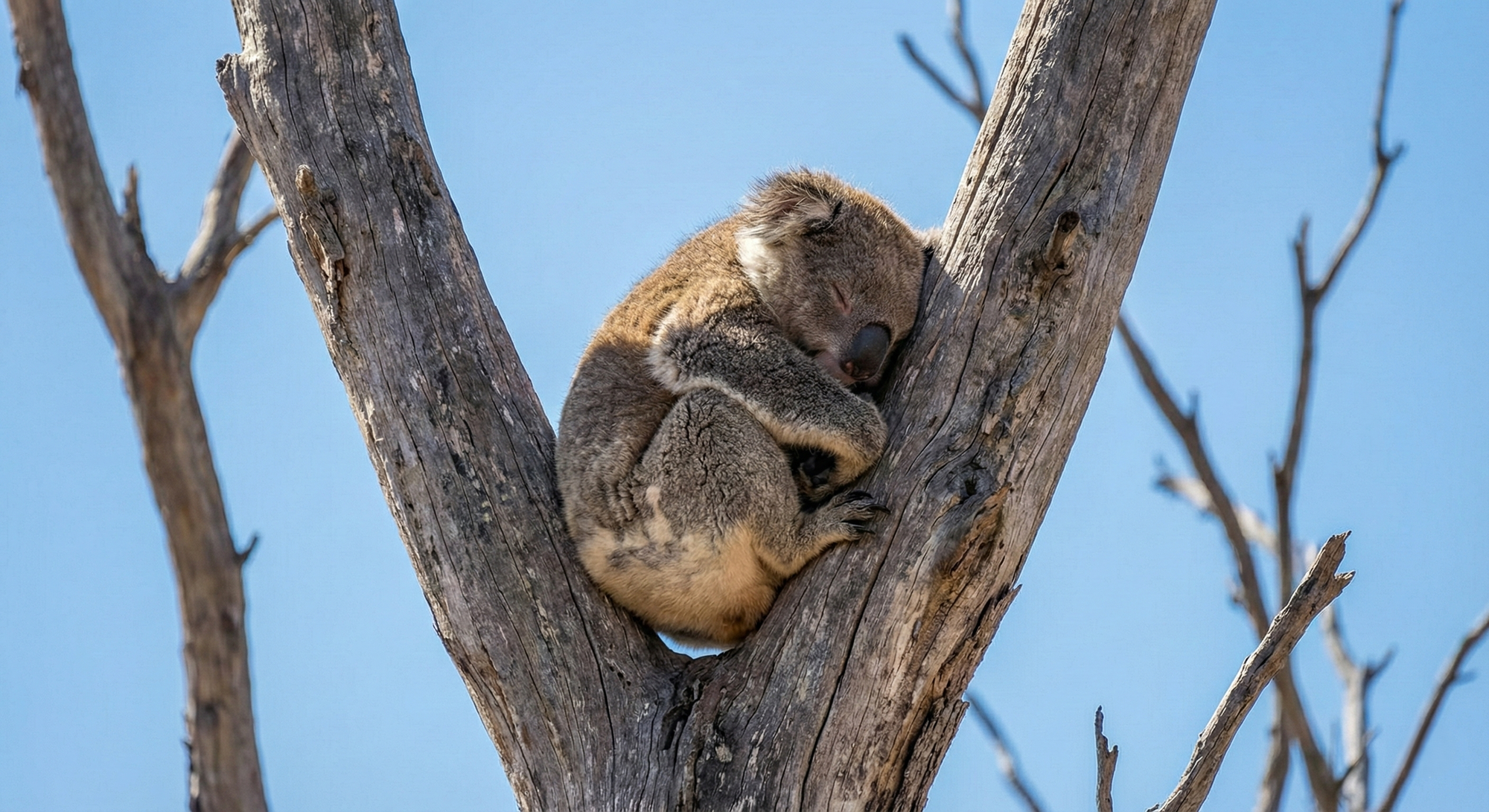
They’ve so overgrazed their eucalypts of choice that many of them can be seen siting high up in dead or dying trees, sad, hungry and in very poor condition.
However, Parks Victoria and the Department of Energy, Environment and Climate Action (DEECA) have ruled out mass relocation as a way to deal with the problem.
Instead, they’ve opted to “manage koala welfare” by progressively euthanising those in the poorest state with the aim of “ensuring the koalas and their habitat at French Island are secure, healthy and sustainable”.
Others, like local tour guide and retired park ranger, Scott Coutts, aren’t happy, telling Gippsland ABC Radio during the week that it should never have got to this.
“It’s come to the point that they've got to do animal welfare assessments. And yes, there are many koalas in a bad state of health due to the lack of habitat, but it should never have got to this,” said Mr Coutts.
“It's just a band-aid treatment that the government's trying to show people they're doing something and they're not actually doing anything except culling koalas in a humane way, apparently,” he said.
“What should have happened years ago, well over 10 years ago was to implant as many female koalas as possible with birth control hormones.
“And 20 years ago, start establishing corridors of koala habitat in places in the national park and even private property, where it was basically denuded by development, by market gardens and other uses that have come into the national park.”
Parks Victoria and DEECA made the following announcement recently:
“Veterinary assessments of French Island’s koalas are underway as part of DEECA and Parks Victoria’s long-term management of koala welfare throughout Victoria.
“This is guided and informed by the Victorian Koala Management Strategy, which was developed collaboratively with Traditional Owners, scientists, veterinarians, animal welfare organisations, wildlife carers, government agencies from Victoria and interstate, and the Victorian community.
“Unlike in other states, in Victoria, koalas are not endangered, and their population is secure.
“Parks Victoria is working with DEECA to continue to monitor and respond to the health and habitat of koalas at French Island, as we have done for many years.
“Because there are no natural predators and largely no disease affecting the introduced population of koalas on French Island, koala numbers have grown.
“The high-density population is putting pressure on the island’s ecosystems, including the eucalypt trees they feed on, resulting in both forest canopy loss and koala welfare concerns.
“Parks Victoria is conducting routine health assessments of individual koalas found in areas of French Island where vegetation has been eaten faster than it can regenerate, with each koala individually assessed by qualified veterinary staff.
“To help slow population growth, healthy females will be implanted with contraceptive devices and released back into their habitat, alongside healthy males.
“To prevent suffering, koalas found to have extremely poor body condition and unlikely to survive will be humanely euthanised. Where the mother is euthanised, her joey will be relocated to the Phillip Island Nature Park.
“Relocation of large numbers of koalas from French Island is not being considered due to the severe risks to the health and wellbeing of koalas, instead focusing on the long-term healthy sustainability of the local population.
“These actions are being taken as part of Victoria’s ongoing management of koala welfare to ensure koalas and their habitat at French Island are secure, healthy and sustainable.”
Asked if he thought some of the koalas could be relocated, Mr Coutts said the potential should be explored.
“You would think so. I mean, we've got huge amounts of habitat in what was called Western Port woodlands around Western Port Bay, which has got the same habitat as on French Island with the mana gum populations. Even though they're quite linear in places, there's still 1000s of hectares but there just doesn't seem to be a will to go there and find the places to take them and to do that.”
Mr Coutts acknowledged that many koalas were in poor health and that their preferred habitat was thinning out and “trees are dying everywhere”.
“It's an over population issue. They're being over-browsed. I'm seeing koalas, mums and joeys, struggling to find any leaves at all, and they're just sitting in dead trees looking so sad, actually looking sad, the koalas that remain,” he said.
Phillip Island conservationist and Friends of the Koalas’ group member Patricia Hunt was also interviewed on ABC Gippsland Radio earlier in the week about the plight of French Island’s koalas.
“Well, I think it's very sad. I mean, we've had the culling over in Western Victoria as well, for a different reason, but I agree what he is saying is very true.
“We've written to DEECA and the State Environment Minister just a week or so ago on the topic of koala management over the whole for Victoria, because it's just wrong.
“With French Island, he's quite right. There's the genetic population. Their genetic situation is not good. And we've just been doing a summer newsletter, and I came across an article from 2012 when one of the wildlife carers was on Four Corners speaking about the French Island koalas, and what she was saying then was that she was getting koalas in that had been translocated from French Island which were actually not genetically good. And she said, I think that there's a problem there. And this is what, 12 years ago, and they should have been aware and started to do something then.”
“On French Island, they did start. They were translocating them, but when the genetic problem arose, I think that's why they stopped the translocation and they started the sterilizing the females. And we don't know why that stopped. I don't know whether it was a money thing but that should have gone on.”
Ms Hunt said the situation on French Island was very, very sad, a product of mismanagement, saying there needed to be a proper strategy for protecting and supporting strong koala populations including those in the Strzeleckis.
And she called on the State Government, Parks Victoria and Phillip Island Nature Parks to use the dedicated reserves on Phillip Island for a breeding program based on strong, diverse genetics.
“We're saying, on the island, we've got two areas of land set aside specifically as koala reserves, but there's hardly any koalas left on Phillip Island, and we think more should be done by the state government and even the nature parks to maybe breed a few there and release them into other areas where we know there's plenty of habitat.”
Ms Hunt said any response needed to include an assessment of how many koalas were left in Victoria, where they were located and their genetics.
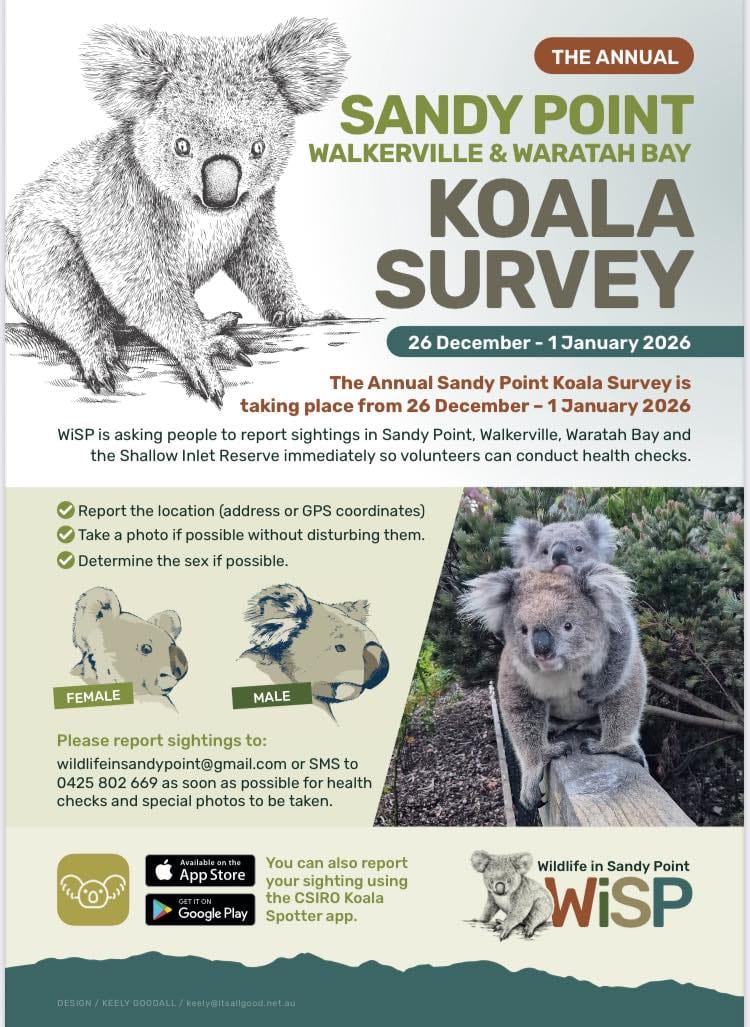
And you don’t have to look far past Sandy Point, Shallow Inlet, Walkerville and Waratah Bay, over the Christmas holidays for an example of what can be done.
Between December 26 and January 1, 2026, the Wildlife in Sandy Point group is asking people to report sightings immediately so that volunteers can conduct health checks.
Simply SMS to 0425802669 or email wildlifesandypoint@gmail.com