

‘Deadwood’ unveiled more than 150 years after shipwreck
A SIGNIFICANT piece of Inverloch’s maritime history was unveiled on Wednesday, December 15, with a restored part of the Amazon shipwreck, known as the Deadwood, going on public display at the Inverloch Community Hub.


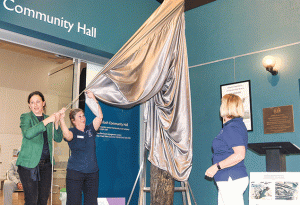
A SIGNIFICANT piece of Inverloch’s maritime history was unveiled on Wednesday, December 15, with a restored part of the Amazon shipwreck, known as the Deadwood, going on public display at the Inverloch Community Hub.
It’s a major step in an initiative to establish a community museum and discovery centre in Inverloch that would house restored parts of the ship, along with artefacts from it.
The Amazon is archaeologically significant as a rare example of an international wooden trading vessel from the mid-19th century.
The unveiling ceremony for the Deadwood took place 158 years to the day since the ship ran aground in an 1863 squall, with all crew surviving the disaster.
After erosion revealed parts of the Amazon in 2018, Heritage Victoria and South Australia’s Flinders University teamed to conduct an archaeological dig at the wreck site near Inverloch Surf Life Saving Club.
“I’m really excited that this piece has been conserved and is now on display for the community,” Heritage Victoria’s Liam Phillips said.
The maritime archaeologist was part of the Amazon dig as a student.
Excavating to a shallow depth revealed the Deadwood, some planking and the central framing timber of the bow, known as the stem.
The Amazon 1863 Project Incorporated, established in 2019, was a driving force in securing state government funding to restore the Deadwood through a Living Heritage grant in November 2020.
The local volunteer group is intent on obtaining further significant funding to enable conservation and preservation of other wooden parts of the Amazon.
“The display of the Deadwood is intended to promote the project and raise funds for further conservation works,” Amazon 1863 Project secretary Karyn Bugeja said.
Other pieces of the ship require far more extensive conservation work than the Deadwood due to the state in which they were found, explained conservator Robyn Hodgson, who restored the Deadwood.
She said it was discovered above the high tide mark, having dried out over approximately three years, while the remaining dozen or so big pieces of the Amazon, so far gathered, were taken from the beach in a wet state.
“When waterlogged and degraded timber dries, in the degradation process, compounds are lost and so it becomes a less dense material and, if it dries out, you get big shrinkage cracks through that degraded area,” Robyn said.
She noted it is necessary to build up the density of the material before it can be dried out, a process that takes years.
That is the intended path for preparing other wooden parts of the ship for exhibition.
However, it is a challenge obtaining the necessary funding for a process that may take up to 12 years, with three years a normal maximum funding period.
“Because they’re all heritage-listed items, we are not allowed to begin a treatment if we’re not funded to the very end and have a home for it to go in,” Robyn said.
The Amazon’s Deadwood is a large, craggy piece of timber believed to have connected the bow to the keel of the ship, with its cragginess due to its natural drying on the beach.
A Deadwood is defined in ‘The Oxford Companion to Ships and the Sea’ as “the solid timbering in the bow and stern of a sailing vessel just above the keel where the lines narrow down to such an extent that the separate side timbers cannot each be accommodated”.
Robyn described the process she undertook to ensure the Amazon’s Deadwood is suitable for public display, noting it was a quick treatment with the work done within a month.
“It’s an epoxy impregnation, so the core of the timber is still rock solid European oak but the outside has major deterioration; what I did was a consolidation process where I put very low viscosity epoxy resin into the friable outer layer to strengthen it,” Robyn said.
She noted the mix had to be just right because otherwise bits could cleave off the Deadwood.
Robyn also created the base on which the Deadwood is displayed so people could see the historical piece in almost its correct orientation as it would have been in the ship.
Most of the Amazon remains buried beneath the sand, but erosion continues to reveal some of its secrets.


