

AI 'ragebait' sparks racist pile-on
Fake image of Middle Eastern men on Phillip Island foreshore draws more than 200 divisive comments as poster admits it was intentional.


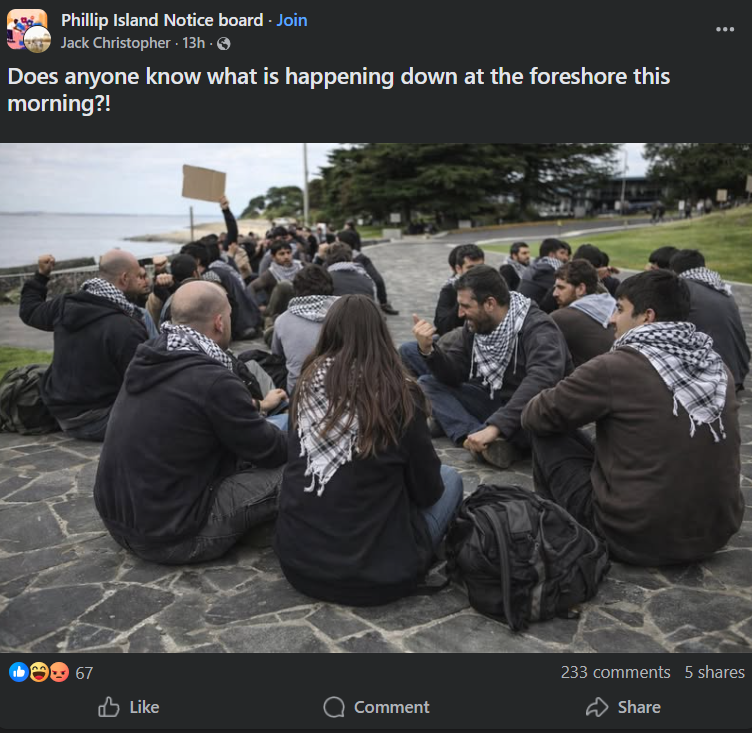
AN AI-generated image of Middle Eastern men on a Phillip Island foreshore sparked a racist pile-on after a social media user posted it to a Facebook group with 35,000 members.
Facebook user Jack Christopher posted the fake image to the Phillip Island Notice Board early on Thursday morning with the caption, "Does anyone know what is happening down at the foreshore this morning?!"
The post drew more than 200 comments including racist abuse and threats of violence along with those supporting the right to protest.
AI detection platform Hive Moderation rated the image as 99.9 per cent likely to have been generated by ChatGPT before the poster admitted it was fake.
The Facebook user told commenters who called him out for inciting hate speech that it was intentional.
"I know, that's the point," he said.
But under new online vilification laws being legislated by the state government, the post would be illegal.
Premier Jacinta Allan this week announced the acceleration of the Justice Legislation Amendment (Anti-Vilification and Social Cohesion) Bill 2026 which specifically targets conduct like the Phillip Island post that incites hatred against groups based on race or religion.
The bill includes tougher penalties for online conduct and comes amid what Ms Allan called "American-style division that is starting to creep more and more into our community."
"There should be no place to hide in this state if you're a racist stirring up hate on the streets or online," Ms Allan said.
The Phillip Island post is an example of "ragebait" - provocative content designed to trigger emotional responses and drive engagement through outrage.
The image showed a group of men of Middle Eastern appearance wearing keffiyehs sitting on what appeared to be the Cowes foreshore.
A keffiyeh is a traditional Arab headdress that has become a symbol of Palestinian identity and is frequently used in anti-Muslim and anti-immigration content online.
Facebook parent company Meta bans threats of violence against religious or ethnic groups, but ‘ragebait’ posts designed to provoke abuse often evade automated detection.
The post comes amid heightened tensions over the Israel-Palestine conflict in Australia with nationwide protests planned against Israeli President Isaac Herzog's visit this week.
AI-generated misinformation targeting the Muslim community spiked sharply after the December Bondi Beach massacre.
The Online Hate Prevention Institute identified 653 pieces of online hate content in the four weeks after Bondi, as fake videos and images flooded social media in the days following the attack.
Responses to the Phillip Island post included, "Looks like a fresh boat load", "TERRORIST SUPPORTERS", "Hopefully waiting for a boat to take them to the Gaza strip" and "Few new arrivals ready to vote for albo."
One commenter said "Waiting for the tide to come in to wash them back" while another wrote "F--- right off. Everyone should go tell them to piss off."
Facebook user Mikhaela Barlow called the post a "dog whistle".
"Someone took an image of the Cowes foreshore and fed it into an AI generator and asked it to insert a group of Middle Eastern men in keffiyehs," she said.
"On its own it's framed as 'just a question' but its real function is to invite fear and racialised assumptions without saying them outright.
"The racism didn't come from nowhere - it was activated."
Carolyn May challenged the post's intentions directly.
"So you admit that this image is an AI creation - what was your purpose in posting this other than to stir up division?" Ms May said.
The Phillip Island post is part of a growing global trend of AI-generated content being used to stoke racial and religious hatred.
The content has been linked to real-world violence both in Australia and overseas including attacks on mosques, synagogues and migrant communities.
Australia's eSafety Commissioner Julie Inman Grant has warned the technology poses serious risks.
"We've now entered an age where companies must ensure generative AI products have appropriate safeguards and guardrails built in across every stage of the product life cycle," Ms Inman Grant said.
"I don't want to see Australian lives ruined or lost as a result of the industry's insatiable need to move fast and break things."
Despite the new anti-vilification laws being legislated, enforcement of online hate speech has historically proved difficult.
At the time of publication, the Facebook post remained on the platform with more than 230 comments.


