

Inverloch's erosion fears hit the airwaves again
HOW much has the Bass Coast Shire Council spent on emergency sand replacement works, to combat storm-surge erosion along the Inverloch Surf Beach? Has it been “approximately $61,000 per year up until this current financial year” as revealed in...


HOW much has the Bass Coast Shire Council spent on emergency sand replacement works, to combat storm-surge erosion along the Inverloch Surf Beach?
Has it been “approximately $61,000 per year up until this current financial year” as revealed in a media release on the shire’s website on Tuesday this week, July 22.
But what about the “$223,000 in erosion response works to address immediate risk to assets and beach access” it delivered between August and December 2024, as stated in the December 2024 council meeting agenda, under the heading “8.3 Immediate Protection of key assets in Inverloch in response to Coastal Erosion”?
Or what about the claim made by Cr Meg Edwards, during a discussion on the topic on social media in the past week, that “Coastal Erosion expenditure was $330,000 in FY2024/25”?
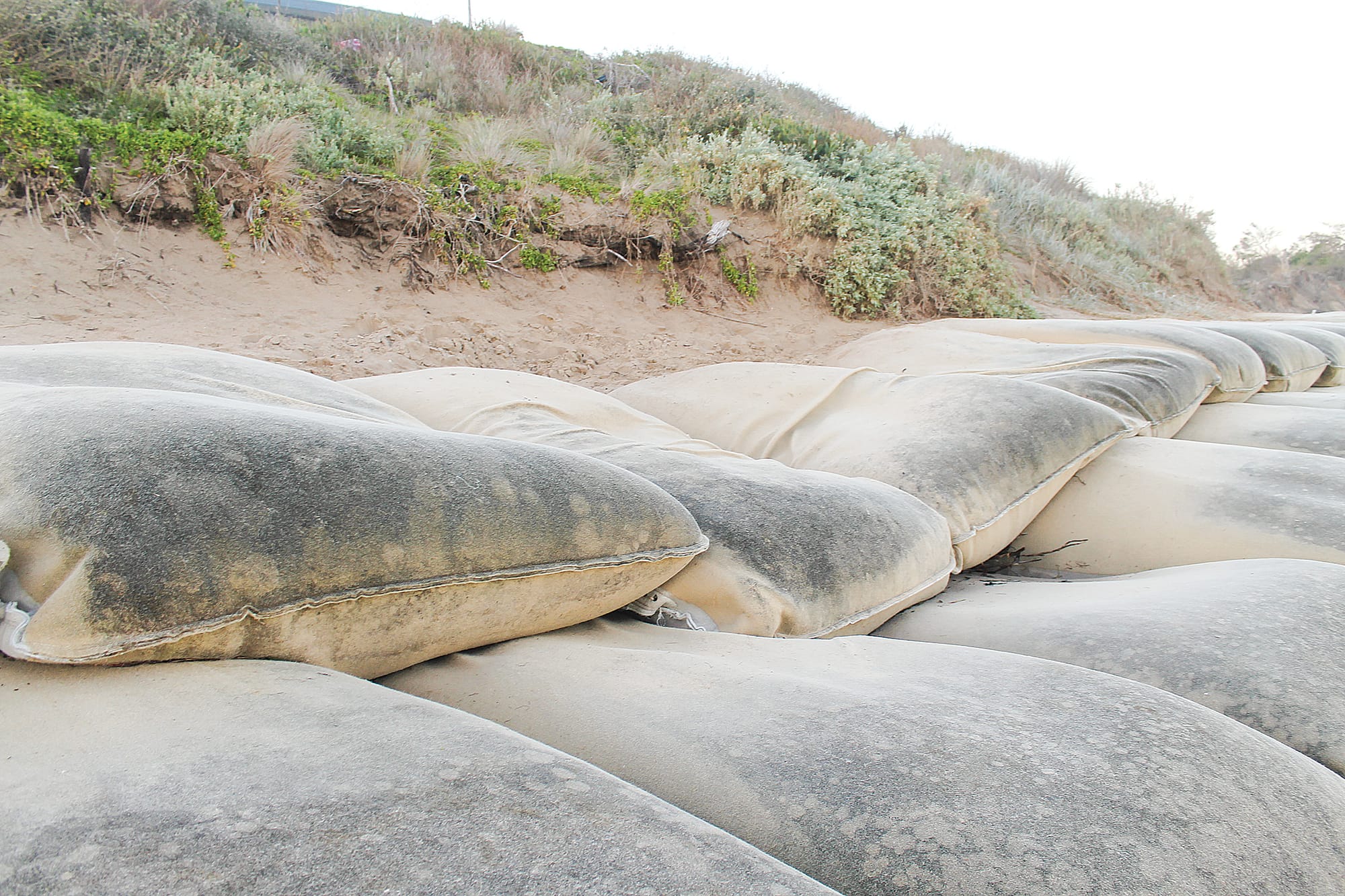
And there’s also the report, in the December 2024 council agenda that “in 2020, Council built a 70m sand-filled geotextile container seawall to protect the Lifesaving Club building, at a total cost of $450,000”.
Has that also been taken into account?
Where the average annual expenditure figure of $61,000 on emergency works at the Inverloch Surf Beach comes from is anyone’s guess, but according to the president of the Inverloch Tourism Association, Glenn Morris, speaking on Gippsland ABC Radio this week, we’d be lost without it.
So, what is the money spent on? Mr Morris was asked.
“What it’s about is that when we get events down at Inverloch that cause localised erosion around, say, the surf club, or the access tracks to the beach from various points that make them inaccessible, the council react quickly and bring in trucks to dump sand and try and temporarily reinstate conditions to be safe,” said Mr Morris.
“And in the case of, say, the access tracks, make sure people can get down to the beach safely, and in the case of the surf club, make sure it doesn't get around the corner of the bags that are there and potentially undermine the club,” he said.
Mr Morris applauded the efforts of the council but said there needed to be a longer-term solution, one that was likely to be well beyond the resources of the council to provide.
“I've got to commend the Council for what they did last year and continue to do and to at least keep the beach safe with those temporary Band Aid approaches.
“But the longer term needs a much more considered and sustainable plan of work. I mean, there is work planned in spring by the state government department, which is going to be a large-scale sand dune construction.
“But even that's got a limited lifespan. I mean, if you read their documentation, it's not going to last more than 14 years, but there are circumstances that could reduce that right down to potentially two, and that's extreme storms and or certain works that they may not be doing.
“So, it is a Band Aid solution in that way, and it's not the proper answer. It is going to require a lot of money, and it's not money that the local council needs to be bearing.”
Asked if the community accepted what amounted to a strategy for managing the immediate impact of storm surges and high tides, without providing long-term protection, Mr Morris said there was no option until the government acknowledged a more permanent solution was needed.
“If they hadn't have done that last year, for example, and even this year, we could have had a situation where the surf club building was at risk, and we have access tracks to the beach which are dangerous. So, they've done something that the state government department hasn't been able to do.
“What really should have happened is that the more permanent work solutions that are being talked about, and some that are planned, needed to have happened a lot earlier.”
Mr Morris said he was aware of the $61,000 average annual figure from the shire but also a report that they may have spent as much as $330,000 in the past year.
“It would be interesting to find out more about that but look, it needs a much more considered, far more expensive, permanent type of solution and it's not council that's going to contemplate doing that. It's going to have to come from the state and federal governments.”
‘Retreat’ is not an option, says surf club
Meanwhile, President of the Inverloch Surf Lifesaving Club, Glen Arnold, has also been hitting the airwaves saying ‘retreat’ is not an option that 100s of homeowners in the firing line at Inverloch want to contemplate, nor do the members of the surf club.
He told the ABC Drivetime on Thursday evening that even if a more permanent solution to the storm surge erosion cost in the order of $20 million it would be money well spent to protect the community.
Here's what he had to say:
So, what’s the situation down there at the moment?
“I guess it's this time of year when we have those high tides, or those spring tides, they call them the high winter tides,” said Glen Arnold.
Mr Arnold said the high tides when combined with storm surges were scouring into the sand dunes with more than 80 metres of beach in front of the surf club, and extending along the foreshore on both sides had been lost in 10 years.
“So the dunes are really being battered, and it's getting close to roads. It's getting very close to the surf club. It's literally three to four metres away from the surf club, which is quite concerning.
“Once those foundations are unstable, then I guess the club has to go. So, we're at that point.
“We don't want to accept the word “retreat” that the government keeps telling us about. We think there's a better and smarter alternative.
“So, there's been a lot of work done by DEECA, a lot of research done through them. And where we're up to now is that it's very drawn out and obviously the community is getting very frustrated here.
“But we're at a point where they're going to extend the sandbag wall, which is for the short term with sand dredging to load on top of that, hopefully, all thumbs and toes and moons and planets aligned that should be done before Christmas.”
But is there a long-term fix?
“Well, that's the thing, you know, that's the contentious issue. So, yes, we think something permanent needs to be done. There's a multitude of solutions that are in play already around, in particular around Victoria, but also around the country.
“For some reason, they're sticking to their plan of dredging sand. They're not really looking at alternatives, which, again, is frustrating when there are some really significant solution in place already.”
What sort of solutions?
“If you look at Apollo Bay and Torquay, for example and even Phillip Island, they’re using rocks, sand, rock bags. They're not, I think, there's a bit of a concern that someone's trying to build the Great Wall of China on the beach. That's not at all the case.
“It's not going to be a hard vertical up and down wall. It's going to represent the dunes, if you like, and then throw sand on top of that, start replanting on top of that, and then off you go.
“So, it may not be perfect, it may not be forever, but it's certainly a more solid structure than just throwing sand at it.”
How much would something like that cost. I see from council’s notes they’re spending an average of $61,000 a year. How much would a more permanent solution cost?
“Oh, look, I'm not the expert in that side of it, but I would have thought it'd be, you know, somewhere around that $10 to $20 million mark.
“It’s not insignificant, but at the same time, in Victoria's language at the moment, let's face it, it's probably petty cash. So, I think, you know, we're not talking about a train station or a tunnel here. We're talking about a community. We're talking about a significant number of houses, you know, 500 odd houses that are at risk.
“And that just doesn't make sense that we would put that in jeopardy when you know, when it can be held at bay.”
Maybe, they’re thinking if they don’t do anything it will just happen and there won’t be any remedy?
“That would be pretty sad if that is a government position. I think for a long time a bit of complacency has set in to the whole conversation down here, and I think it's like, who in their right mind, or which government in their right mind would let my house sink.
“I'm sure it will get sorted out would be the general sense but it's not being sorted out. It's dragging on. And so, you know, this isn't a fresh conversation. This has been a conversation going backwards for forwards for quite some time.
“We’re not the only ones in this situation. There are other areas around Victoria in particular that are having the same concerns, but we just don't understand what we're missing down here.
“Why are we so unique that we just can't get a more significant solution, and at least a conversation about a more significant solution. They’re really hell bent on just sort of sticking to their original plan of dredging sand with the ultimate plan of retreat, which I don't see as a recommendation.”
How urgent is it now?
“Well, the Council have been doing a great job at pushing sand up around, in particular to protect the club. And I guess, you know, the club is going to be the first thing that's going to fall into the water. So, we’re like the canary in the coal mine right.
“So, the council has done a good job of keeping the sand up around the edges of the sandbags and across the sandbags.
“So, they have done a good job in anticipation of this further sandbag work, which last heard is on schedule between September and hopefully December, so it can't happen soon enough.”
Council statement
Here’s what the Bass Coast Shire Council said in its “Coastal Management across Bass Coast” statement in the past week.
Bass Coast Shire Council is committed to being transparent about how it manages coastal erosion and risk across the region, including at Inverloch Surf Beach.
For the last four years, Council has allocated a dedicated annual budget of approximately $150,000 under its Coastal Risk Management Program.
This funding is used to respond to urgent coastal erosion issues across Bass Coast, including at key, high-risk locations such as Inverloch, Silverleaves, Cowes and Kilcunda.
The average expenditure at Inverloch has been approximately $61,000 per year and up until this current financial year, has been relatively low. This reflects the relatively mild weather conditions during this period, following the installation of a sandbag sea wall in front of the Surf Life Saving Club building in 2020/21.
Coastal erosion is highly dependent on prevailing wind and wave conditions. For example, in some years, such as between 2021 and 2024, sand naturally builds up (accretes) on the Inverloch surf beach. In other years, like this one, strong winds and waves result in sand being eroded from the beach and transported eastward toward Point Norman and into Anderson Inlet.
This financial year (2024/25) will see a significant increase in investment at Inverloch Surf Beach with $330,000 allocated for coastal works.
Across Bass Coast more broadly, the Coast Risk Management Program has supported projects at Silverleaves, Cowes and Cowes East. In 2023/24, $46,000 from this program was used for sand renourishment at Silverleaves. The Victorian Government’s Department of Energy, Environment and Climate Action (DEECA) has contributed $60,000 to this work.
In total, DEECA has contributed $164,000 to the sand renourishment works undertaken across Bass Coast since 2021/22.
Council continues to work closely with DEECA and advocate to both State and Federal Government on behalf of the Bass Coast community. Monitoring and responding to coastal conditions will also continue. As erosion risks vary from year to year, Council’s approach to budgeting for these works will remain flexible.
To learn more about coastal erosion management or view past project updates, visit Engage Bass Coast.


