

Is Bass Coast’s “cruel” TAFE gap being ignored?
Only one out of 200 Bass Coast College Year 12 students went on to study TAFE last year, fuelling claims that Bass Coast is being left behind.


Only one out of 200 Bass Coast College Year 12 students went on to study TAFE last year, fuelling claims that Bass Coast is being left behind.
The statistic has further aggravated long-running concerns that local students are completing VET subjects at school, but finding they have no realistic public TAFE pathway waiting after graduation.
Bass Coast College teacher Malcolm Beasley said the figure wasn’t a sign that local students lacked interest in vocational education, but rather evidence of a failed system.
“It’s a colossal mistake thinking that demand for TAFE is not present down here,” Mr Beasley said.
“Looking at comparable LGAs, it’s obvious if a TAFE presence is in the region, students opt to attend.”
Mr Beasley said the one student who went to TAFE in the city studied beauty and was committed and supported enough to travel.
“Many of our young people don’t have that luxury,” he said.
The overall figures are just as stark.
According to Mr Beasley, Bass Coast College produced just over 1000 Year 12 graduates in the period of 2020 to 2025.
Only about 22 of those went on to study at TAFE.
That’s roughly two per cent, compared to a statewide average of 8.5 per cent and 14 per cent in the Latrobe Valley.
Mr Beasley said Bass Coast College students were completing VETDSS subjects in areas including hospitality, cookery, health support, construction, furniture making, screen and media and visual arts, but when they finish school, many have nowhere to go.
“That’s the cruellest part of this,” he said.
“These students have already done the hard work, they’ve completed VETDSS units in hospitality, cookery, construction, health support, furniture making, visual arts, screen and media.
“They’ve shown the aptitude and the interest. And then they hit Year 12 graduation and there’s a cliff edge.
“No local Certificate III or IV in any of those areas. So either they travel, which for a lot of families isn’t realistic, or they simply don’t continue.
“We’re building skills in school and then abandoning the pathway the moment it matters most.”
Chisholm currently offers a small, limited number of courses through its Bass Coast campus in Wonthaggi, including early childhood education and care, accounting and bookkeeping, school-based education support, individual support, and a new Certificate III in Pathology Collection.
But it still lacks broad local pathways in key hands-on areas such as building and construction, hospitality, cookery, automotive, engineering, horticulture or IT.
Mr Beasley says those gaps can’t simply be dismissed.
“These aren’t speculative suggestions, they map directly onto what Bass Coast College is already teaching at VETDSS level,” he said.
“Chisholm wouldn’t even be guessing at demand; the pipeline already exists in our timetable.”
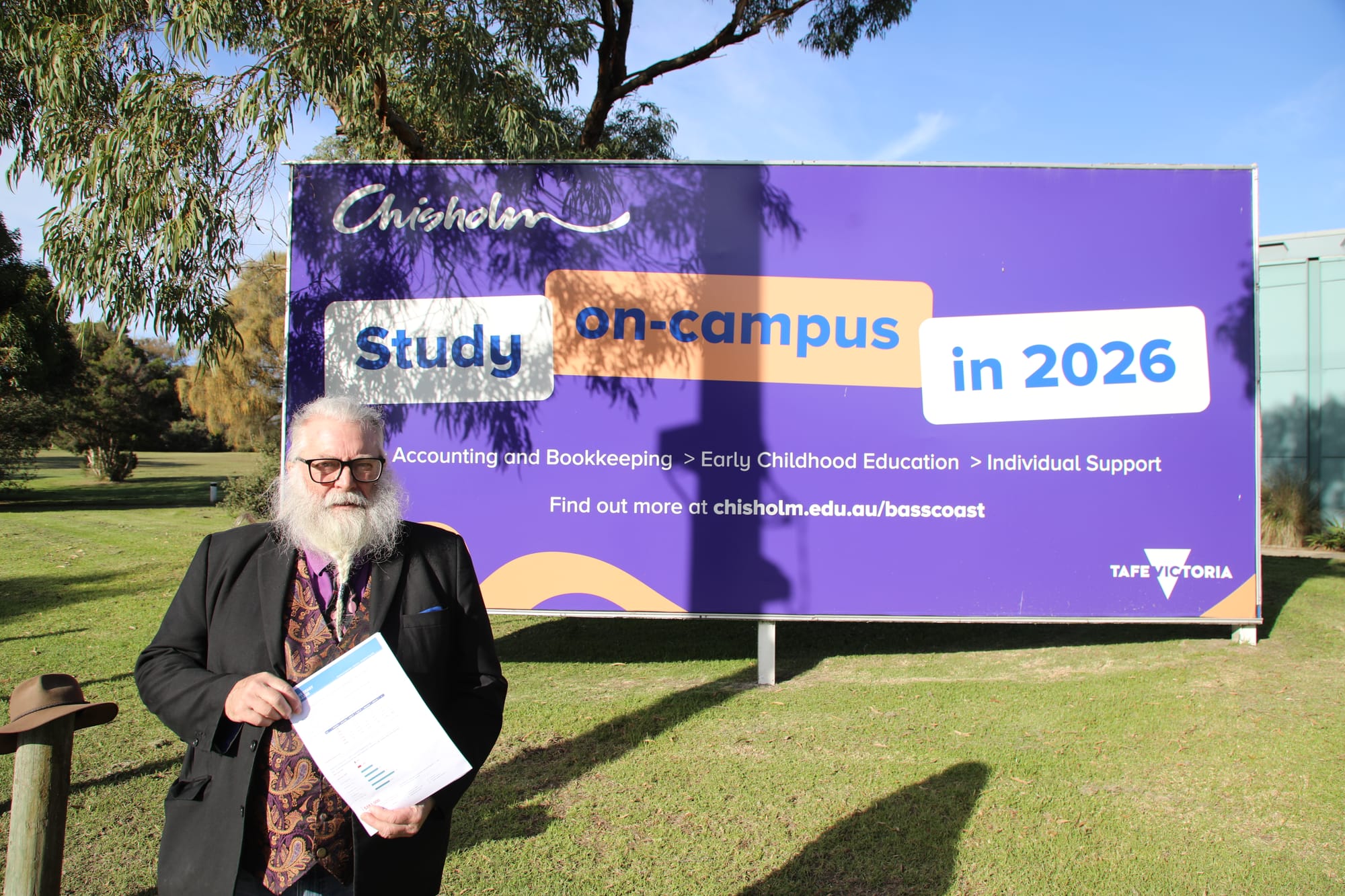
In response to questions from the Sentinel-Times, Chisholm did not directly answer whether it considered the one-in-200 statistic evidence of a local access problem.
Nor did it directly say whether it had plans to expand face-to-face delivery at the Wonthaggi campus.
A Chisholm spokesperson said the institute continued to work alongside the Bass Coast community to deliver education that reflected local interests and supported workforce needs.
They then pointed to the fact that Chisholm currently has 600 students enrolled across campuses who reside in South-West Gippsland, Baw Baw or the Latrobe Valley, including more than 100 students who are between the ages of 17 and 19.
“Supporting students to transition from secondary schooling, including VET subjects, into further education or employment is a priority,” the spokesperson said.
“Student pathways after Year 12 are shaped by a range of factors, and our focus is on continuing to build awareness of local training options and strengthening connections between schools, students, and industry so those pathways are clear and accessible.”
Chisholm also said the recent addition of pathology collection at the Bass Coast campus was an example of local feedback informing course expansion.
However, critics say that does little to address the lack of practical, hands-on pathways that are available for school leavers in a fast-growing coastal region.
The contrast with other parts of the state is also becoming hard to ignore, as on June 22, Minister for Skills and TAFE, Colin Brooks, unveiled designs for a new $55 million Kangan Institute campus in Melton, featuring workshops for construction, gas fitting, welding, refrigeration and plumbing, as well as an emerging technologies lab and cybersecurity simulation space.
In a media release, Mr Brooks said the new campus would save Melton locals time and money.
“We are one step closer to delivering a brand-new world-class TAFE in Melton, saving locals time and money,” he said.
Meanwhile in Bass Coast, students seeking hands-on training in many of those exact same fields are being asked to travel, study online, or in some cases, abandon further training altogether if none of those options are possible.
The Sentinel-Times asked Mr Brooks whether Bass Coast students currently had adequate access to TAFE pathways after school, whether there were plans to expand face-to-face offerings at Wonthaggi, and what would need to happen for more hands-on courses to be delivered locally.
In response, the minister’s office simply asked for the source of the one-in-200 statistic, which was then provided.
No response was received before the deadline.
The lack of a response has added to concerns that local calls for a stronger TAFE presence are not being heard.
Mr Beasley said that, at its core, the result of all of this is a generation of students being pushed away from formal training.
“You can’t choose a course that doesn’t exist,” he said.
“The demand is there. It’s the supply that’s missing.”
He said students are being left with limited options: leave the region, get an apprenticeship without a strong local training system, or simply take whatever work is available.
“Australia needs tradespeople more than ever,” he said.
“These are the exact graduates a regional TAFE campus exists to serve, and right now we’re failing them.”


