

2019 ‘drowning black spot’ report finally released
ON THE same day that the South Gippsland Sentinel-Times carried a front-page article headed “Signs of Neglect”, highlighting how local foreshore management authorities had ignored recommendations contained in a “Beach Drowning Black Spot...


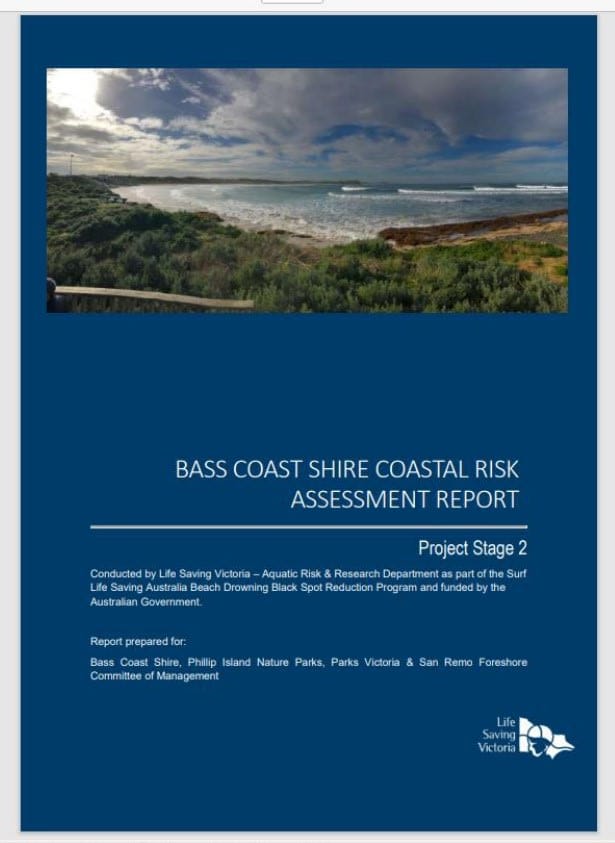
ON THE same day that the South Gippsland Sentinel-Times carried a front-page article headed “Signs of Neglect”, highlighting how local foreshore management authorities had ignored recommendations contained in a “Beach Drowning Black Spot Reduction Program” assessment report dating back to 2019, the full, 164-page report was released for the first time.
Several Bass Coast Shire Councillors, who claim they had never sighted the report, including the Deputy Mayor Cr Rochelle Halstead, also requested a copy of the full report last Tuesday, following the publication of the Sentinel-Times article.
A copy of the report was passed on by local public affairs activist Graham Jolly who has been making representations to various authorities since 2019 for the report to be released.
But it’s not the first time those councillors have heard about the ‘Bass Coast Shire Coastal Risk Assessment Report 2019’ (Project Stage 2), conducted by Surf Lifesaving Victoria for local foreshore management agencies Bass Coast Shire, Phillip Island Nature Parks, Parks Victoria and San Remo Foreshore Committee of Management.
The San Remo Foreshore Committee of Management was quietly disbanded in late 2020 with its responsibilities handed over to the Department of Environment Land Water and Planning (DELWP).
On September 18, 2019, he posed a question for the monthly council meeting, asking if council had received the report, what the recommendations were and what action had been taken. He also asked if the report had been provided to the elected councillors and when it would be made public.
But the question was diverted away from the meeting as “general correspondence” and was never answered beyond being acknowledged as received.
Little more than a month later, council released its executive summary of the report and a joint statement by council and Life Saving Victoria, which among other things noted that “Bass Coast Shire ranks the second highest Local Government Area in Victoria for fatal drowning events”.
At the December 16, 2020 council meeting he asked another question about the ‘Life Saving Victoria Black Spot Risk Assessment for the Bass Coast 2019 ‘ report.
“Please provided the total listing of recommendation listed in the report for all stakeholders. The Black Spot Risk Assessment for the Bass Coast 2019 report identified actions council is to consider for ongoing public safety. List all council actions including completed actions as of 14/12/2020.
Response: “The report provides high-level recommendations across a number of areas including education and information, providing warnings/signage and activity management, lifesaving services and increasing survival skills. Life Saving Victoria take the lead on water safety and drowning prevention initiatives that foster resilience in communities and encourage active participation in aquatic recreation.
“Council meets regularly with Life Saving Victoria, Victoria Police, Phillip Island Nature Parks and Parks Victoria, in relation to coastal risk mitigation activities and how to provide consistent messages to the community about beach safety.
“Council Beach Safety Signage is consistent with AS/NZS 2416 and Council recently reviewed and improved signage in Kilcunda taking into consideration feedback provided in the report.
“The key message from Life Saving Victoria is to plan your trip to the beach this summer. All beaches, even can be dangerous and have hidden dangers such as rips. Make sure to check the weather and conditions, use the beachsafe.org.au website to find patrolled beaches, read safety signs and always go swimming with a friend.”
But now, five years after that report was completed and presented to the local agencies, it has finally been released in full.
Recommended actions
The Bass Coast Shire Coastal Risk Assessment Report recommends the following actions:
The recommended treatment options provided here are based on expert opinion and international best practice outlined in the Drowning Prevention Strategies: A framework to reduce drowning deaths in the aquatic environment for nations/ regions engaged in lifesaving (ILS, 2015). Given that the recommendations are provided as aggregated recommendations specific to most beach locations within each Zone, land managers should endeavour to adopt the most appropriate hazard treatments specific to the organisational capabilities and in consultation with relevant stakeholders – including other land managers.
Treatment options that are selected and implemented strategically and uniformly by all land managers are likely to be more effective.
One key risk treatment strategy proposed for all sites is signage and this report strongly recommends a Shire-wide uniform signage strategy. Used on public land specific to aquatic recreation drowning and injury event minimisation; it should be implemented in a coordinated and consistent manner. One way to ensure consistency is to implement signage using a baseline standard or framework.
The AS/NZS 2416 – Water safety signs and beach safety flags Standard is considered the baseline reference document specific to aquatic safety signs. The current approach to signage within the BCS is not consistent. There are sections of the BCS coastline without signage, and where there is signage in place, its application is not always consistent with the design intentions of the AS/NZS 2416 Standard.
Often, several important sign elements are not consistent within immediate or adjacent areas. This includes aspects such as colours, use of non-standard symbols and variation in design of the same symbol. The basis for all sign design, sizing and placement decisions should be based on a clear and concise communication objective.
It would be advantageous for all BCS land managers to agree on a LGA-wide communication objective first and foremost, then develop subset objectives and design requirements for smaller areas or individual beaches. This would facilitate development of a hierarchical signage approach for the whole BCS that then offers land managers flexibility in installing site specific signage consistent with the wider application objective.
Finally, it is recommended that the land managers within BCS commit to a systematic monitoring and review process. Continuous monitoring and review of hazards ensures that new hazards are detected and managed and linked to modification or maintenance of existing action plans. Ongoing reporting will communicate the activities and outcomes, provide information to inform decision-making, improve risk management activities and facilitate interaction with stakeholders.
An attached table outlines the recommended treatment options for BCS beaches by factor and assessment Zone. For each application (e.g. School education, Electronic & digital media, Leaflets/ brochures) and each Zone, a treatment score is provided.
The treatment scores range from 0 to 1 and are assigned according to the following criteria: • A score of 0 indicates that a control measure application is not suitable for that Zone. • A score of 0.25 or 0.5 provides indication of a conditionally suitable control measure application for that Zone or beaches within a Zone.
It may be conditional based on BCS Blackspot Project Coastal Risk Assessment Report 156 requiring other control measures to be implemented concurrently or prior to the adoption of the suggested control measure. An example of ‘conditional suitability’ is on-site education applications such as public address and/or face-to-face messaging. These on-site education measures require trained personnel such as lifesavers/ lifeguards and/or park rangers to be on-site to deliver the on-site messaging/ education. • A score of 1 suggests that the control measure application is already in place or should be adopted.
It is not a mandatory action; however, land managers should consider the measure given resourcing capacities and relationships with other vested parties that can help implement the control measure. Where control measure applications are already in place, the land manager, under a risk management philosophy, should monitor and review these controls at least annually. From time to time amendments to existing control measure and application may be needed. Other times control measures may need to be abandoned altogether and/or substituted with other or combination of other control measures and applications.
Click here to read a full copy of the report: https://d3pbdxdl8c65wb.cloudfront.net/n/569/2024/Feb/01/BCS Coastal RA Stage 2_LSV.pdf


