

Berninneit closed on Friday for greenwashing*
You can't visit the Berninneit Cultural Centre in Coews on Friday because the shire has all the doors and windows sticky taped shut for an energy efficiency test. WE have it on reliable authority that the Berninneit cultural centre at Cowes failed...


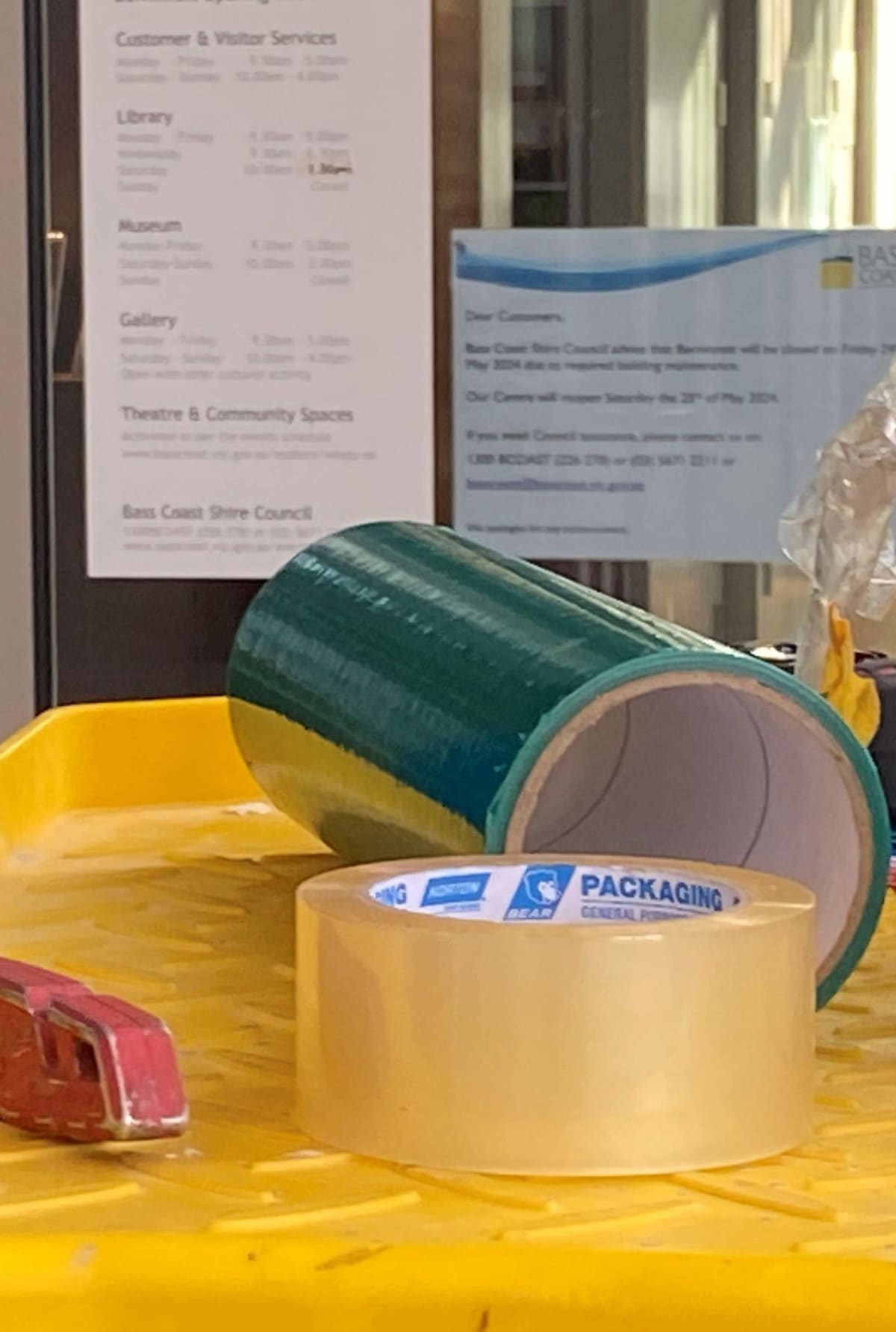
WE have it on reliable authority that the Berninneit cultural centre at Cowes failed its Passivhaus accreditation assessment last week, meaning that it did not achieve the rigorous energy efficient design standards that were one of the key goals of the whole $32 million project.
Having failed to prove its energy efficiency and design credentials during normal operations, the Bass Coast Shire Council is believed to be preparing for another bite at the cherry.
After advising the community via Facebook on Wednesday that “Berninneit will be closed to the public on Friday 24th of May due to the final Passivhaus assessment being undertaken which involves the final inspection and air test,” contractors spent most of the day on Thursday taping up all door, window and vent openings with sticky tape in an effort to achieve the required airtight levels needed to reach Passivhaus accreditation.
But some Phillip Island locals have been critical of the shire’s attempts at “greenwashing” a building that will not comply with the required environmental standards during usual operations.
“If it doesn’t achieve the standards because it’s not airtight, then so be it. The building is probably very efficient anyway. Just don’t be trying to fool the people, and especially appease the green lobby, by coming up with an outcome that simply isn’t sustainable in normal operations,” said a Sentinel-Times’ reader this week.
“What happens after they take all the sticky tape off and open up the building again? It’s just ridiculous to be trying to claim the highest levels of efficiency under those circumstances.”
There is also the issue of how much extra it cost to add the greater levels of insulation than typically needed, the triple glazing and insulated frames, mechanical ventilation and airtight design to go after Passivhaus accreditation that has been a catchcry of the project, and allegedly, key to its prestige.
The former mayor, Cr Michael Whelan is quoted on social media by the builders, McCorkell Constructions, as describing Berninneit as “a Passivhaus” masterpiece before it had even been tested for accreditation: “A Passivhaus masterpiece, where the soul of art, performance, culture, and community is immortalised upon the canvas of Phillip Island for generations to come.”
So, who pays if Passivhaus accreditation is not achieved or if it is only achieved in contrived circumstances?
External doors and windows “must not be temporarily sealed”
Here is an aid to understanding the key principles involved in achieving the airtightness performance required to meet the Passivhaus standard.
The information, sourced from UK firm the BRE Group, an independent, third-party consultant providing certification for fire, security and environmental products and services, also describes how to ensure that the building is correctly air pressure tested for compliance with Passivhaus certification (n50) pressure test requirements.
General information about the importance of eliminating air leakage in Passivhaus buildings:
“Unwanted air leakage significantly increases the space heating demand of a building, as well as causing occupant discomfort from cold draughts. Air leakage can also lead to long term problems in the building fabric where it is repeatedly damaged by the transmittance of water vapour which results in interstitial condensation. In areas affected by atmospheric pollution unwanted air leakage can contribute to reduced levels of Indoor Air Quality (IAQ). Achieving the advanced Passivhaus standard of airtightness (in conjunction with the use of appropriately designed ventilation systems) will help to eliminate these problems.”
Specifically, the BRE Group describes what to do when preparing the building for air-tight testing:
“In preparation for the pressure test the building’s ventilation system must be closed and sealed. In residential buildings this will involve sealing the MVHR inlet and extract ducts from the external air. The inlet and exhaust ducts should be sealed at their external ends to avoid testing the MVHR unit or internal ductwork. Note that in non-residential buildings using intermittent ventilation strategies (e.g. schools) where the ventilation system is turned off during evening and weekend periods (to save energy), the inlet and exhaust must have tightly shutting flaps to ensure that additional heat is not lost from the building (as air leakage) when the ventilation system is turned off. When testing Passivhaus buildings with intermittent ventilation systems the sealing flaps must be closed during the pressure test but must not be sealed over. All water traps must be filled, or if no water is present in the building these traps must be temporarily sealed. Other openings in the external envelope like doors, windows and loft hatches must be closed for the duration of the test, and must not be temporarily sealed. All sealed openings must be noted and recorded in the test report. Internal doors must be wedged open for the duration of the airtightness test to ensure an even distribution of air pressure throughout the building.”
Repeat: “…other openings in the external envelope like doors, windows and loft hatches must be closed for the duration of the test, and must not be temporarily sealed.”
BRE is registered with the Passivhaus Institut as an official Certifier for Passivhaus Buildings.
See UK firm BRE Group's Passivhaus Air tightness Guide:https://d3pbdxdl8c65wb.cloudfront.net/n/569/2024/May/26/BRE_Passivhaus_Airtightness_Guide.pdf
Greenwashing*
Greenwashing is the process of conveying a false impression or misleading information about how a company’s products are environmentally sound. Greenwashing involves making an unsubstantiated claim to deceive consumers into believing that a company’s products are environmentally friendly or have a greater positive environmental impact than they actually do.
In addition, greenwashing may occur when a company attempts to emphasize sustainable aspects of a product to overshadow the company’s involvement in environmentally damaging practices. Performed through the use of environmental imagery, misleading labels, and hiding tradeoffs, greenwashing is a play on the term “whitewashing,” which means using false information to intentionally hide wrongdoing, error, or an unpleasant situation in an attempt to make it seem less bad than it is.


