

Passing of a local football legend
~ Vale Alan Hart ~ THE recent passing of Alan Hart signalled the end of the life of one of the most decorated footballers in South Gippsland. Alan migrated from England as a one-year-old and grew up in Kilcunda where his father was a coal miner...


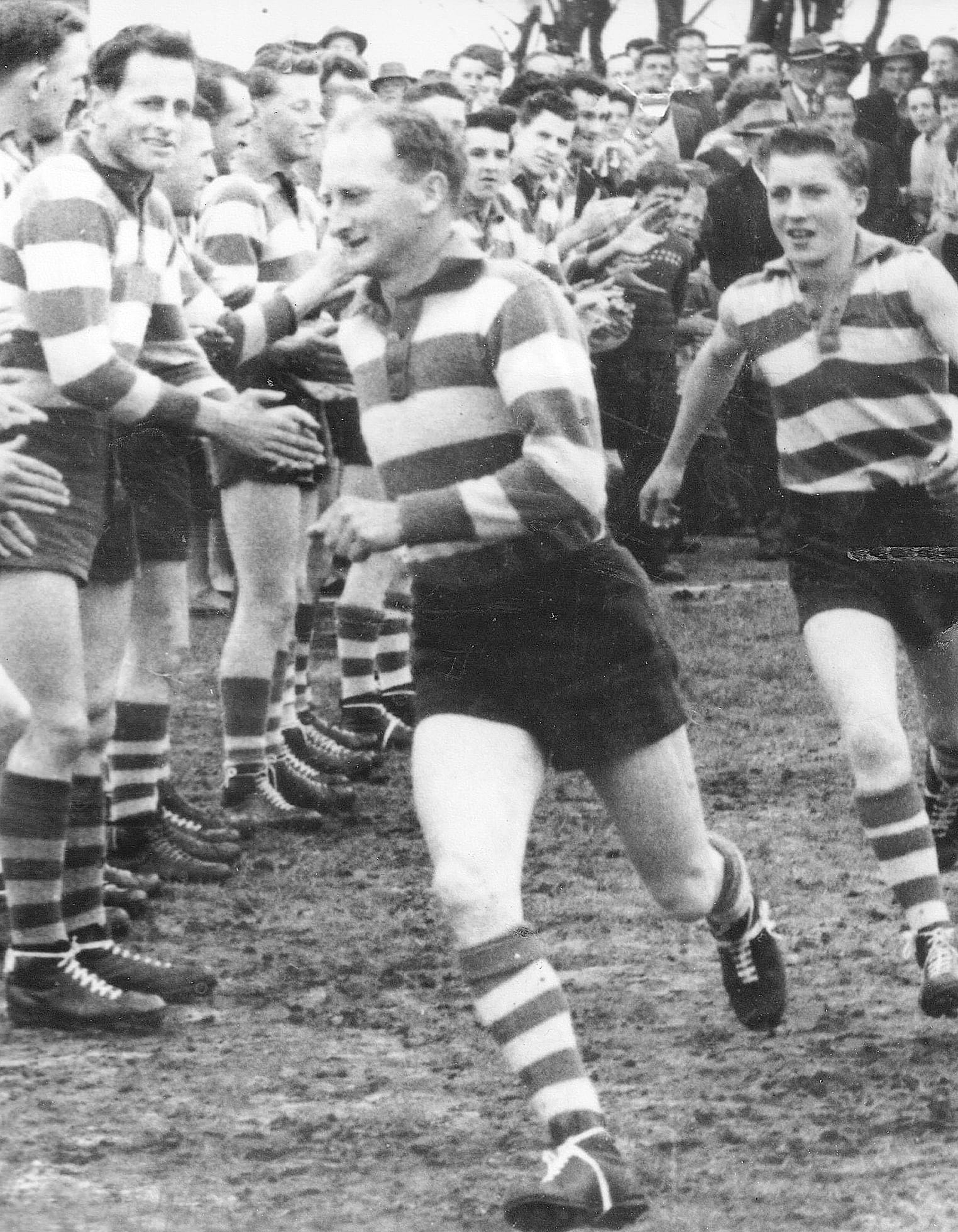
~ Vale Alan Hart ~
THE recent passing of Alan Hart signalled the end of the life of one of the most decorated footballers in South Gippsland.
Alan migrated from England as a one-year-old and grew up in Kilcunda where his father was a coal miner.
Alan was a very humble man who was very reluctant to talk about his achievements.
The dissolution of clubs and leagues resulted in the loss of many records, so it is hard to definitively document his career.
He started playing relatively late and first played at Dalyston in 1945.
Kilcunda did not have a team during World War 2 and quite a few players from Kilcunda played at Dalyston.
In 1946, the Kilcunda Football Club was recreated and joined the Wonthaggi and District Football League.
Alan joined Kilcunda at that point and though there are no records of his achievements, he was invited to train at Fitzroy that year.
He played in a practice game with Fitzroy against a combined Bendigo League side because Fitzroy were looking for a centre man and he was already considered an outstanding centre man.
Alan was a country boy at heart and didn’t like the prospect of living in Melbourne.
His good form continued because in June 1948 he received a letter from the Melbourne Football Club inviting him to train there.
They offered to find him employment, accommodation and after 6 games membership to the MCC. Given the value of membership these days it was a pretty attractive offer.
Up until 1950, he played at Kilcunda with his brothers Tom and Jim who moved to Sale for work.
Both Tom and Jim had outstanding football careers and are both legends of the Sale Football Club.
Jim also coached the Latrobe Valley Football League to the Victorian Country Championship. There are no records of this period, and little is known about whether he won best and fairest during this time.
Given he won best and fairest pretty much every year where records exist and VFL clubs were trying to sign him, there is a fair chance he did.
In 1951 he joined Korumburra who were so keen to secure his services that A.E. Wilson and Sons, a Korumburra House removalist and club sponsor, arranged for a car to collect him from his home at Archies Creek and take him back home on game day.
The driver apparently liked a drink and though he didn’t mind a drink himself he often wondered how they got home some nights.
At Korumburra he won the best and fairest by a street in 1952 and was so highly regarded that he made their equivalent to team of the century.
In their team of the century booklet, he was described as a brilliant centreman.
The book also states, “he was so highly respected in Korumburra that he and his family were given a public send off. He had been a fine leader and clubman.”
In 1953 he joined Glen Alvie and played the ‘53 and ‘54 seasons where he won the best and fairest both years and was a member of the ‘54 premiership side where he was awarded the best on ground medal.
He also made their team of the century.
It’s interesting to note that he never met the games played criteria for team of the century for Korumburra and Glen Alvie, yet his contribution was so significant that he made both sides. It should also be noted that as much as he loved footy it was also a job for him.
He was earning less than three pounds a week working at the Archies Creek butter factory and up to 10 pounds a week for playing football.
VFL players were earning much less than that in those days and this could be part of the reason playing in Melbourne was of no interest to him.
In 1955 he was back at Kilcunda where he had an immediate impact.
It was the first year of the Bass Valley and Wonthaggi District Football League and he won his first Kerslake Medal for best and fairest of the league.
There are two newspaper articles claiming that he won four Kerslake medals, but this cannot be confirmed.
Records show he won the 1955 and 1960 Kerslakes and he definitely won three but a fourth cannot be confirmed.
Alan was also runner up for a League medal while playing at Korumburra.
He missed out by one vote but had missed four games with an injured knee.
In 1957 Kilcunda and Bass merged with instant success winning the premiership.
It is most likely that he won one of his Kerslakes that year because he won it in 1960 which was another premiership year.
He retired at the end of the 1957 season but was coaxed back into playing late in 1958 and was a member of the Reserves premiership team where he was voted best on ground.
He was back playing senior football in 1959 and in 1960 aged 34 won the club and league best and fairest and was best afield in the premiership side.
Alan finally retired at the end of the 1961 season and umpired for many years and was also on the League tribunal.
He was also named in the Kilcunda Bass team of the century.
It is very rare for footballers to be named in two teams of the century let alone three.
Alan’s life in football reflects who he was a person.
He was a humble man and though a high achiever did not like the limelight.
He was a friendly person without being overly outgoing and having played at so many clubs made long friendships with players and supporters from all over South Gippsland.
As a footballer he was quick, smart, an exceptional ball user and had more than enough mongrel in him to manage the attention he got from opposition teams.
In many of the newspaper articles from that time it was inferred that to beat the team he was in his influence had to be minimised.
Though he was often targeted he generally gave better than he got and was quite comfortable getting in first.
He was extremely nimble on his feet and early on in his football career, it was suggested that he could have had a career as a soccer player and that English soccer clubs would be interested in him.
He had an amazing work ethic and because he was being paid, he always wanted to ensure he earned his pay.
Alan died on June 4, two weeks after his 96th birthday.
He lived on his farmlet at Kilcunda until late April and remained fit and active until the end.


