Signed up for action - Petition calls for hard engineering works
- Petition calls for hard engineering works immediately THOUSANDS of Inverloch people have already signed a petition calling on the State Government “as a matter of urgency to undertake immediate planning and engineering works to protect main...


THOUSANDS of Inverloch people have already signed a petition calling on the State Government “as a matter of urgency to undertake immediate planning and engineering works to protect main beach and save the Inverloch Surf Lifesaving Club”.
Those yet to sign the petition, at dozens of businesses around the town, have until the end of the day today, Tuesday, September 10, to add their name to the 4000-plus signatures that are needed before the petition is presented in State Parliament this Wednesday, calling for the issue to be debated on the floor of the Legislative Council.
A 10,000-strong online petition is set to follow.
“We’ll get there. It’s a tight timeframe but we’ve already got 3500. We just need 500 more. The phone has been ringing non-stop, ‘where can I sign it, where can I sign it’,” said Inverloch Surf Lifesaving Club President Glenn Arnold.
There’s a level of urgency about signing the petition that’s been absent from the serious erosion problem at the beach, in front of the surf club, right now.
“Personally, I’d like to see another rock wall built along this section of the beach, the part that’s been copping most of the impact. And not right out the front of the surf club but further out and for it to be backfilled so that a section of the beach can be reclaimed.
“I’m no expert, but rock walls have done their job at other places along the foreshore. They can be filled with sand and planted out, like the one VicRoads did up at the RACV Resort end of town, but ultimately rocks can be removed if it’s not the permanent solution.
“But something has got to be done now.
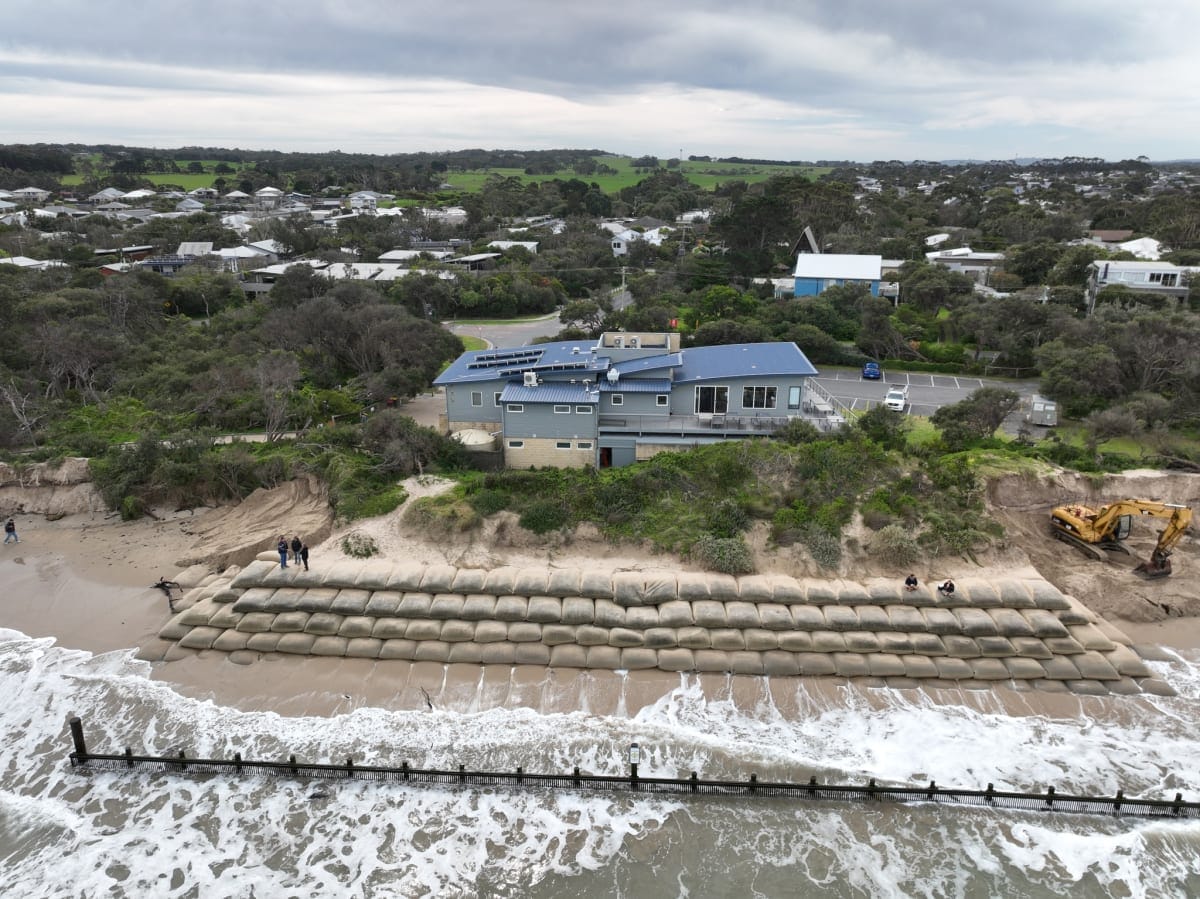
“The geotextile bags they put in four years ago have done their job, but they couldn’t stand up to the hit they received last week.
“The erosion is now getting in behind them.
“Some people I have spoken to say the surf club shouldn’t have been built so close to the water. But it wasn’t. It was 70 metres or 80 metres back from the high-tide mark, you couldn’t see the beach.
“But this isn’t just about the surf club.
“If you’re happy to see the surf club fall into the ocean in the first instance, it opens the floodgates for the houses and infrastructure behind it and I don’t believe that’s an acceptable option.
“The club would be just the first thing to fall. You’ve got the houses, roads and other infrastructure to be replaced or paid for. How much would that cost in terms of money and disruption?
“Honestly, I don’t believe retreat is an option right now, not for us when you consider the cost of replacement, and not for the private property and infrastructure behind.
“The Cape to Cape Resilience Plan talks about scenarios in 2040 and 2070 when the sea level is expected to rise 20cm or so but this is not about that. It’s about the here and now, what’s happening now.”
Mr Arnold said right along the Inverloch coastline, rock walls had been doing the job for many years, at the Inverloch Dog Beach, the old rock wall, between the boat ramp and the bowls club, around the Anderson Inlet beach and at the other end of Surf Parade.
“You mightn’t like them but they’re a solution that works. We’ve already seen that.”
The Inverloch Tourism Association has also weighed in saying the loss of beach access, the surf club and any impact on houses and property values would have a devastating impact on the town.
“We believe a combination of hard engineering and dune nourishment is needed but dune reinstatement will take a long time, action is needed now to stop the surf club sliding into the sea,” said ITA President Brian Robinson.
“We might be lucky and this is the end of the storm surge action this year, but it will return again next spring and they’re not due to finalise the Cape to Cape Plan until July next year. That’s too long.
“And they’re talking about a response over the next five to 10 years after that.”
Mr Robinson said a whole range of options was considered in the report including groynes, breakwaters, rock walls and dune renourishment but the hard engineering option was something that could be acted on immediately.
“They’ve had four years. They’ve clearly done a lot of work on it already.”
Mr Robinson acknowledged that it wasn’t just about the economic impact, there were the emotional, social and environmental considerations as well, but a case study in the report indicated a loss between $2.5 million and $7.4 million annually to businesses if access to the surf beach was restricted.
“Other business people I have spoken to say that’s very much on the low side and we haven’t talked about what it would do to the town if private property along the foreshore was impacted. It would destroy the community,” he said.
Eastern Victoria MP Melina Bath is sponsoring the petition into State Parliament saying this week there has been a huge outpouring of concern about what’s happening at Inverloch.
“The government has had its head in the sand for the past four years while they’ve been doing their Cape to Cape plan and they haven’t taken the action they needed to take in a timely manner,” Ms Bath said this week.
“The petition is about sending a message to the Allan Government that action is needed, and it’s needed now.”
Local MP Jordan Crugnale, a resident of Inverloch, has closely monitored the situation.
In a Facebook post last week, Ms Crugnale talked about renourishment works (funded by a $3.3 million grant we got from the Australian Government’s Coastal and Estuarine Risk Mitigation Program in 2022) but claimed respondents to Cape to Cape consultation said “dune and beach renourishment was seen as appropriate, but with a preference for no groynes”.
“Hard engineering options such as seawalls, breakwaters and groynes were seen as less appropriate,” she reported as the outcome of the consultation.
But that doesn’t align with the response to the petition, which calls for engineering works, or general talk around the town.
“We are taking all this very seriously, I have been speaking with the Enviro Minister, his office, DEECA, Council to ensure everyone is working together, being proactive and actioning all that is necessary to protect the club, assets and make the area as safe as possible,” Ms Crugnale said.
“I want to assure everyone that there is action and that DEECA is part of the Inverloch Inter-agency Working Group which is helping to coordinate these works.”
Ms Crugnale has been asked for comment about the rock wall proposal and other hard engineering options. See Ms Crugnale’s comments below.
As well as the Acting General Manager Place Making at the Bass Coast Shire Council, Donna Taylor, the Inverloch Surf Lifesaving Club also presented at the State Government’s Inquiry into Climate Resilience hearing in Traralgon last Tuesday, represented by President, Glenn Arnold, and Treasurer Stephen Duncan.
The storm surge incident at Inverloch, in the week leading up to the hearing received considerable discussion.
What to do about Inverloch’s erosion
SOME say build a rock wall in front of the Inverloch Surf Lifesaving Club and do it now.
Others are dead against “hard” engineering solutions such as rock walls, breakwaters and groynes for fear the beach amenity will be lost.
But one question remains to be answered – will it work?
Jordan Crugnale MP has been asked for comment:
“I have visited the surf club and beach area a number of times and met with the club representatives.
“They are a very active club who want clarity, protections, timelines and an assurance we are doing everything we can. They are in constant communication with Council as the land managers as well.
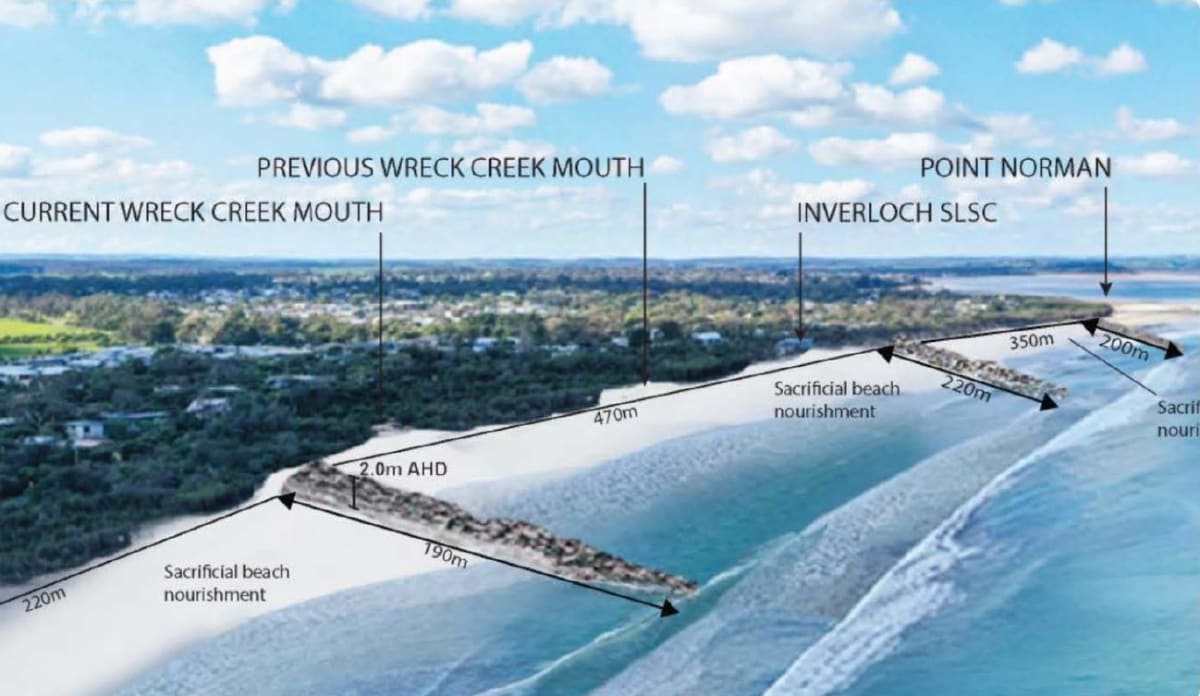
“The Cape to Cape (C2C) plan very clearly outlines the present day pathway being nature-based dune enhancement and restoration which is an engineering solution and this is what is being done and the designs tender process is also underway. This is being funded as part of the $3.3 million federal grant we got back in 2022 under their Coastal and Estuarine Risk Mitigation Program.
“The interim protection structures installed in 2019 at the Surf Beach have functioned as predicted, protecting the land and assets immediately behind them. However, as we know and see, at each end of the geotextile and rock seawalls there is significant erosion.
“The Inverloch Inter-agency group is working together, responding to the erosion, actively monitoring the area, are on site, and will be led by the data, modelling, recent drone surveys and marine and coastal experts if there needs to be further work on the interim protection structures outside of what is being done and planned.
“DEECA are working with Bass Coast Shire Council, Department of Transport and Planning, Parks Victoria, Heritage Victoria and the West Gippsland Catchment Management Authority to respond to the erosion at Inverloch Surf Beach.
“With so many opinions going around on what will work and what won’t, I ask people to refer to the C2C plan where the adaption pathways are clearly listed, are really informative, speak to the dynamic coastline we have and the many engineering options from dune restoration to seawalls are all mapped out with pros and cons, with photo montages and backed by the modelling, data and technical studies.
“The report also very importantly, speaks to the community engagement we did about what people valued about our area – with the surf beach it was the beach.
“This is what needs to be messaged out and the local media have an important role here to inform our community.
“We looked at rock walls, groynes, reefs, dredging, breakwaters and assessed each and they all have a significant impact on for example the beach amenity, sand movement, access with steep sloping dunes, with potential impacts to Anderson Inlet entrance and pushing erosion further east. People need to be mindful that this is the Bass Strait, the ocean bedrock is shallow which is why the sand moves around so much and we also have a very dynamic estuary – this is complex.
“I have asked the Minister’s office to assist in bringing together DEECA, Council, Watertech and key stakeholder representatives from the Surf Club, ITA and Sth Gippsland Conservation Society as a start to outline the immediate works plan, go through the adaptation measures, timelines so we can also reassure our community we are continuing to be proactive and providing real time information.
“Community members have spoken about not wanting to be like Portsea which saw rocks and sand bags put in and now has no beach. The C2C engagement work we did with community is that they want the beach.
“The Inverloch working group which comprises of agencies including DEECA, Bass Coast Shire Council, Department of Transport and Planning are all working together to respond to the erosion, and I have also kept the Minister and his office updated on the concerns being raised by the Club in particular as too community sentiment.”
Ms Crugnale has also penned a letter to locals (edited for space):
Dear Inverlochians
This weather has brought significant erosion along our coastline especially at the Surf Beach area. It is described as a 1-in-10 year storm surge event due to the high winds, waves and elevated ocean levels.
I want to acknowledge how distressing it is to our community with more bad weather to come. The visuals across the community, media and Surf Club socials are alarming and have been coupled with the Amazon reveal which has certainly drawn a crowd.
Heritage Victoria have been onsite and a big thank you to the local Amazon 1863 Project Group who have been there making sure it is protected, appreciated and safe guarded.
We are taking this very seriously, I have been speaking with the Enviro Minister, his office, DEECA, Council to ensure everyone is working together, being proactive and actioning all that is necessary to protect the club, assets and make the area as safe as possible. We are.
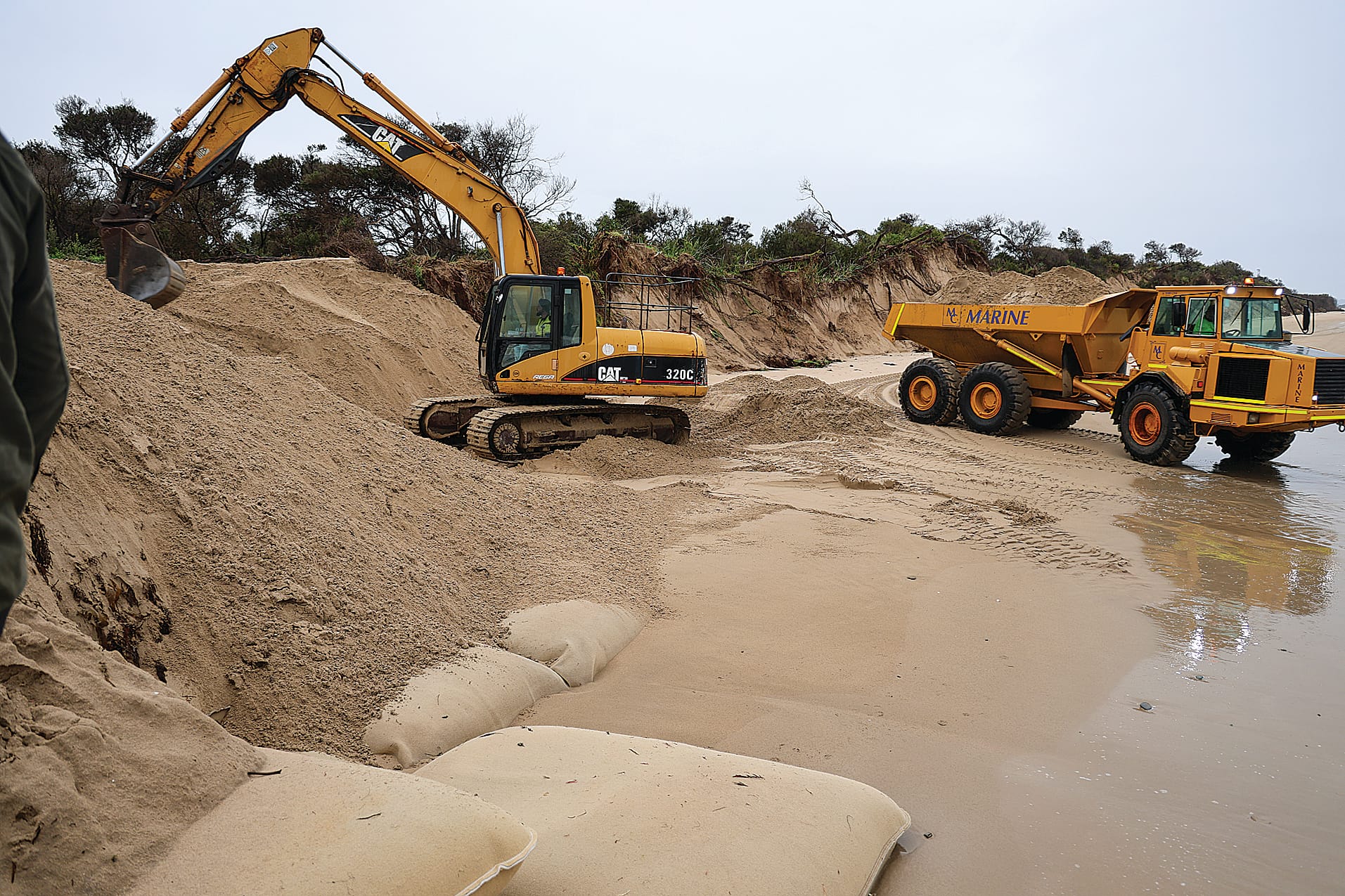
As many have seen, Bass Coast Council as the land manager are currently undertaking immediate safety works around the Surf Life Saving club.
I want to assure everyone that there is action and that DEECA is part of the Inverloch Inter-agency Working Group which is helping to coordinate these works..
Further renourishment works are planned with dune reconstruction designs currently in the tender process.
Renourishment works are funded by a $3.3 million grant we got from the Australian Government’s Coastal and Estuarine Risk Mitigation Program in 2022.
In ITA’s media statement they mention the need for ‘dune strengthening alongside sand replenishment’ which is exactly what is being done and being planned.
The C2C plan has had a lot of consultation since 2021 and importantly input into what people value and cherish about where we live. It is all on the website and includes hazard maps, fAQs, photo montages of different treatments canvassed and more.
Go to: www.marineandcoasts.vic.gov.au/coastal-programs/cape-to-cape-resilience-project
For Inverloch surf beach:
* Respondents want some form of action, with non-intervention not seen as appropriate.
* Dune and beach renourishment was seen as appropriate, but with a preference for no groynes.
* Hard engineering options such as seawalls, breakwaters and groynes were seen as less appropriate.
* Planned relocation of assets and/or changed land use and infrastructure upgrades/redesign were seen as appropriate.
There has been some confusion also with the C2C Plan and people saying that 2040 is too far away for action. In the image the darker purple is present day, the lighter purple is 2040. What we are seeing is within the modelled hazard zone and the report is not out of date. The report on page 58 details the pathway.
The interim protection structures installed in 2019 at the Surf Beach have functioned as predicted, protecting the land and assets immediately behind them. However, at each end of the geotextile and rock seawalls there is significant erosion.
DEECA are working with Bass Coast Shire Council, Department of Transport and Planning, Parks Victoria, Heritage Victoria and the West Gippsland Catchment Management Authority to respond to the erosion at Inverloch Surf Beach.
The Cape to Cape Resilience Plan is a long-term strategy, encompassing present day conditions, hazards and technical assessments, and predicted changes such as rising sea levels, coastal flooding and the impact of erosion between Cape Paterson to Cape Liptrap for the decades to come.
It’s really vital that communities between Cape Paterson to Cape Liptrap share their feedback on the Cape to Cape Resilience Plan. Go to https://engage.vic.gov.au/cape-cape-resilience-project
“DEECA and all the relevant agencies are working together to address the erosion in Inverloch, and I will have more to say soon as to the works planned,” said Ms Crugnale.