

Be persistent with weeds
THERE is immense interest in weed control in South Gippsland, judging by the number of participants at South Gippsland Landcare Network’s field day last week.


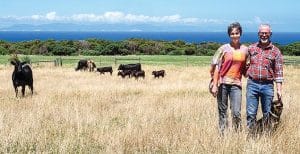
THERE is immense interest in weed control in South Gippsland, judging by the number of participants at South Gippsland Landcare Network’s field day recently.
Fifty people attended the event which was held at Bruce Whittaker and Jillian Staton’s beef farm at Cape Liptrap and included talks from Agriculture Victoria’s education and engagement officer, Jenny Bell, and the head of Bass Coast Landcare Network’s works crew, Mark Rowe.
Bruce and Jillian described how, over a period of eight years, they transformed the agistment block into an important part of a productive beef enterprise. Ongoing control of capeweed, thistles, bracken and tussocks is integral to the process, they said, along with good grazing management to encourage pasture growth.
The couple also control weeds for environmental purposes, naming blackberry, agapanthus, mirror bush and kikuyu as the main threats to biodiversity.
Working across 312 acres, Bruce takes a pragmatic approach to weed control, using chemicals to get on top of large stands of weeds, and then a combination of spot-spraying and physical removal to deal with individual plants. His key piece of advice involves the “three Ps”.
“You need to have a plan, you need to carry out regular performance reviews, and you need to be persistent,” he said.
Participants were able to see the results of the 3Ps on a walk that took in many of the improvements the couple have made to the farm, such as new stockyards, water troughs and shelter belts.
The high environmental values of the property, which borders the Cape Liptrap Coastal Park, were also on display.
Botanist Lorraine Norden and ecologist Alison Oates were excited to see many plants belonging to the Heathy Woodland Ecological Vegetation Class (EVC) on the track to Grinder Point, which led to a discussion about the impacts of feral deer on native vegetation.
Jillian and Bruce are among many landholders at Cape Liptrap (and other parts of South Gippsland) who have noticed a significant increase in deer numbers over the past few years.
As well as destroying trees and shrubs, deer damage pasture and waterways and spread diseases that can harm humans, stock, wildlife and pets.
The key to effective deer control is coordinated action involving all landholders.
SGLN is establishing two action learning groups at Cape Liptrap and Corner Inlet to facilitate on-ground control works over winter 2022.
Interested landholders should contact Jenny O’Sullivan at leapjos@gmail.com (Cape Liptrap) or Nick Stephens at nick.stephens@sgln.net.au (Corner Inlet) for more information.
SGLN also has a vast collection of resources about weed identification and control (including non-chemical control) on its website at sgln.net.au.
The Bunurong Coast Community Onground Action on Pest Plants and Animals Project is supported by the state government through the Community Volunteer Action Grants.


