

Historic trees overshadow $85M Cowes hotel project
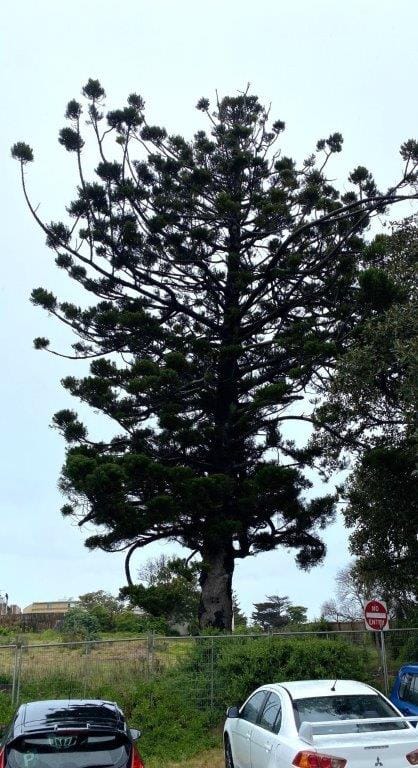
This rare example of a Hoop Pine, on the site of a proposed $85 million hotel development in Cowes has not yet been decided despite the Bass Coast Shire Council ruling that it must stay. THE National Trust of Australia (Victoria) announced last week...


THE National Trust of Australia (Victoria) announced last week that it had included nine remarkable trees, from Toorak to Port Fairy, in the running for the prestigious title of 2023 Victorian Tree of the Year.
And while it wasn’t one of the official contenders, the famous Morton Bay Fig, on the corner of The Esplanade and Bass Avenue in Cowes (old Isle of Wight Hotel site) could easily have been right up there.
Typically, the award not only highlights one of the state’s top tree treasures, but also one that may be under threat from development or “progress”.
When the Bass Coast Shire Council approved a planning permit last month for the development of an $85 million, 7-storey hotel on the site of the old Isle of Wight, neither the developers nor the council considered the removal of the iconic tree. It stays no matter what.
But the developers have proposed the removal of 18 others, including an extremely rare example of a Hoop Pine, likely planted by Baron Von Muller, the director of the Royal Botanic Gardens, Melbourne (1857-1873) in 1869 at the same time as he planted the Moreton Bay Fig.
Many of the 39 objectors to the project raised concerns about conditions around the protection of the trees being ignored, especially with regard to the Morton Bay Fig and Hoop Pine, saying they feared the developers would ignore the regulations when push came to shove.
Here’s what council had to say:
“The development has sought to retain the Moreton Bay Fig tree which has been elevated in importance by being listed as a design objective within the schedule to the DDO. The Moreton Bay Fig (Ficus macrophylla) has a height of 16 metres and spread of 25 metres and has been confirmed by the applicant’s arborist as having a very high retention value and is in the northeast corner of the site.
“It has been assessed as having good vigour with a long Safe Useful Life Expectancy of 30-60 years. The tree holds an important historical significance to the area, being planted by Baron Ferdinand Von Mueller, and was classified on the National Trusts of Australia’s national register of significant trees.
“Its broad canopy overhangs the site as well as the footpath and road of both The Esplanade to the north and Bass Avenue to the east, providing significant amenity and shade. It is prominent in the landscape and can be seen from the surrounding neighbourhood, the foreshore reserve, the beach, and the water beyond.”
A beer garden is proposed in the vicinity of the Morton Bay Fig but council has made it a condition of the permit that no structures are allowed within 15 metres of the tree.
The council has also opposed the removal of the Hoop Pine.
“The applicant has proposed to remove the Araucaria cunninghamii (Hoop Pine) which is situated behind the Moreton Bay Fig tree. The submitted arborist report observed dieback in the upper canopy with multiple stubs from previous branch failures and recommended removal due to its limited safe useful life expectancy (SULE).”
But Council’s Arborist strongly rejected its removal.
“It is considered to have cultural significance with the specimen likely planted by Baron Von Muller in 1869 at the same time as the Moreton Bay Fig. The specimen provides a living link to the colonial history of Phillip Island and a historically significant site on the Island. Due to extensive logging, there are very few examples of mature Hoop Pines. This specimen, which is intact, and of good condition is extremely rare. Hoop Pines are slow growing species that can have lifespans of up to 450 years with this particular tree estimated to be 150 years and of a condition that is suitable to be retained at this location and could continue to thrive at this location for years.”
So, saving the Morton Bay Fig is a lock, but not so the Hoop Pine.
“The Hoop Pine has a historical and environmental significance and has been recommended for retention by Council’s Arborist and Officers. The permit applicant will be required to lodge revised plans to show the tree as retained,” said council in its decision last month.


