

Why coastal protection is in a ‘very poor’ state
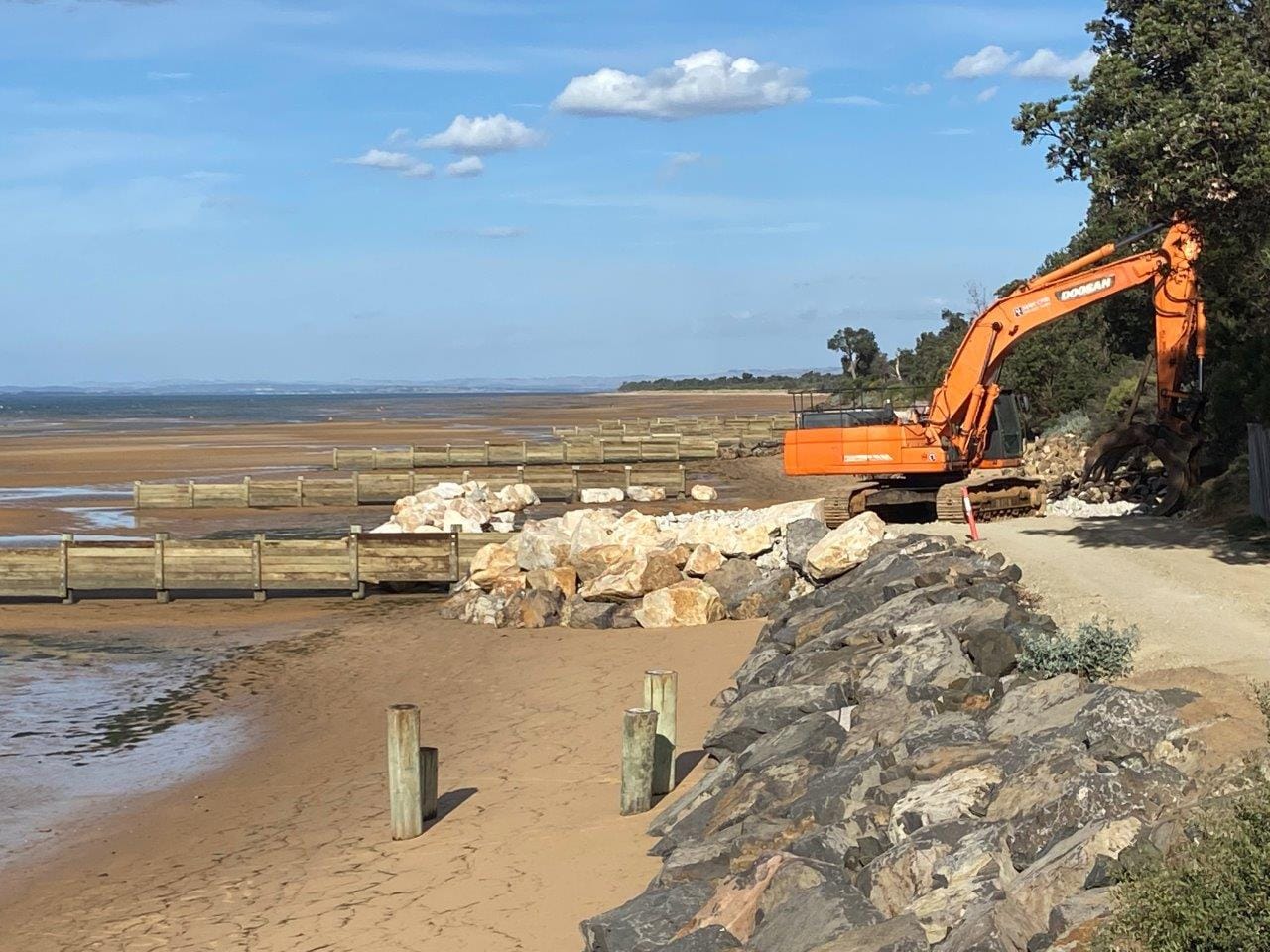
IT’S no wonder that the coastal protection structures, including the groynes and rock walls, along the Cowes foreshore, between Rose Avenue and Coghlan Road, fell into disrepair. Or that no one in authority moved to address the erosion happening...


IT’S no wonder that the coastal protection structures, including the groynes and rock walls, along the Cowes foreshore, between Rose Avenue and Coghlan Road, fell into disrepair.
Or that no one in authority moved to address the erosion happening along the surf beach at Inverloch and in Anderson Inlet until it threatened an important road and residential areas in the town.
While the Department of Environment, Land, Water and Planning (DELWP) and the 54 organisations that are supposed to look after our coastal protection assets (CPAs), as delegated coastal managers, including the likes of the Bass Coast Shire Council, knew there were problems, there was no structure in place to assess their performance, no report on the condition of assets, no strategy, little expertise and precious little money to deal with the problems beyond a knee-jerk response.
There still isn’t.
There might have been plenty of jumping up and down about the impact of climate change, but until a 2018 audit report by the Victorian Auditor-General’s Office (VAGO) found weakness in DELWP's management of many of Victoria’s 1572 coastal protection assets and the oversight of coastal managers; no one had the wherewithal to do anything about.
They didn’t even understand the scope of the problem much less know what to do about it in any coordinated way.
As the management guru Peter Drucker famously said, “If you can't measure it, you can't manage it.”
During the week, VAGO produced a report following up on the recommendations from its 2018 ‘Protecting Victoria’s Coastal Assets’ audit and the news was good and bad.
While VAGO gave DELWP a positive report overall for addressing its 2018 recommendations, it highlighted the extent of the neglect of Victoria’s coastal protection assets and the fact that there was still no plan in place to deal with it, much less the funding or manpower.
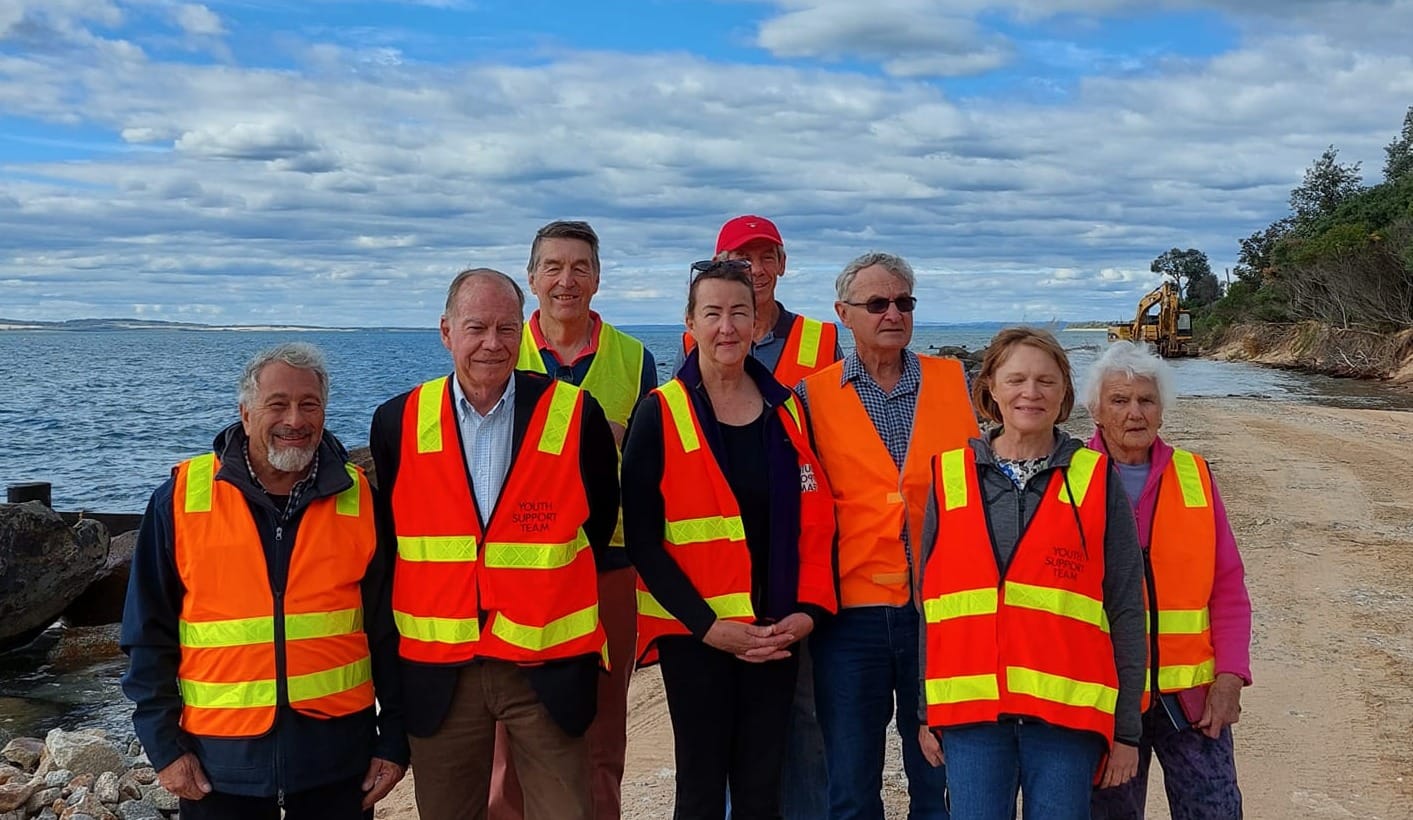
Chair of the Cowes East Foreshore Preventative Action Group, Ken Hailey is not surprised.
While he has highly praised the efforts of the Bass Coast Shire Council, and Mayor Cr Michael Whelan, for getting behind the issue at Cowes with funding and support he said the group’s experiences were clearly symptoms of a wider Victorian problem.
“It took us a long time to get someone to listen to us. We’re getting action now, with $3.35 million committed to the work, including $1.1 million from the Federal Government and the rest from the council, but there’s still more to do.”
Mr Hailey said eight new groynes had been constructed to reduce the impact of erosion and a 350-metre gap in the rockwall added, with the remainder raised to 2070 height, but seven more groynes, east of Erehwon Point needed to be replaced, as well as a further six “dangerous and degraded” groynes elsewhere.
The issue of beach erosion at Silverleaves is another pressing problem, he said.
“My other concerns are the lack of any funding from the State Government and the lack of any coastal structure engineering expertise in Gippsland since the recent retirement of Bill Storer (DELWP).
“The rest of them are just sitting around eating muffins, aren’t they?”
DELWP has modelled the task of managing and maintaining the CPAs from 2021–41 but the cost of interventions is still in the early stages of development.
“With many assets being in poor condition, fix-on-fail may be still occurring while DELWP addresses a backlog of asset maintenance,” said VAGO in its report.
DELWP is also yet to complete its risk treatment planning project.
Structures 'poor or very poor'
As part of developing an inventory of the coastal protection assets, in response to VAGO’s 2018 recommendations, DELWP completed a condition report on 1516 of its 1572 known structures, including breakwaters, groynes, retaining walls, revetments, seawalls, wharfs and other structures and found that only 35% were in a good or very good condition.
There were 512 of these assets (34%) in a poor or very poor condition. The rest of the assets, 467 (31%), were in only a fair condition.
Some of the assets, which were partially buried, couldn’t be graded for their condition.
The report also found that “regional DELWP staff still need more resourcing to ensure they can give CPAs more attention, including the delegated coastal management of CPAs”.
As well as raising concerns about the lack of a sustainable funding model, the report also identified there is still “no clear mechanism to monitor coastal managers' performance” including that of the Bass Coast Shire Council, San Remo Foreshore Committee of Management and the Grantville and District Foreshore Committee of Management.
In 2018 VAGO found DELWP had limited oversight of coastal managers. This made it harder for DELWP to integrate its planning with coastal managers' and develop risk-based approaches to managing CPAs.
To address governance and oversight issues, VAGO recommended that DELWP:
* Adequately resource its oversight role
* Clarify coastal asset management roles and responsibilities, including the performance measures it will hold coastal managers accountable for.
What DELWP has done to address the VAGO recommendation:
DELWP has completed its Marine and Coastal Policy 2020 (the Policy) and Marine and Coastal Strategy 2022 (the Strategy). These address the recommendation in the 2018 audit and establish strong foundations for the state's marine and coastal management.
The Policy and Strategy have clarified DELWP's and coastal managers' roles and responsibilities for managing coastal assets.
They also offer some principles to support the oversight of coastal asset managers.
However, while the Policy and Strategy lay the foundations for better statewide oversight of coastal asset managers, DELWP is yet to establish monitoring and evaluation processes to oversee and support coastal managers' performance.
DELWP has oversight of over 1500 coastal protection assets, valued at approximately $1.13 billion in total. This infrastructure helps protect Victoria's coastline from hazards including inundation and erosion.
DELWP oversees 54 organisations that look after these assets as delegated coastal managers.
One of the issues to be assessed by DELWP was “coastal hazard and risk assessment". VAGO claims in its report that this aspect has been "completed" by DELWP.
“Collection of hazard data has improved. DELWP has updated its state-wide coastal hazard assessment and DELWP has made coastal hazard data available to coastal managers.”
Locally, we are yet to see the final outcome of the Cape to Cape Resilience Project, much less the funding in a State Election Year to deal with the work required.


