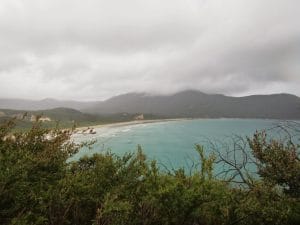
Whale or something washed up on Oberon Bay
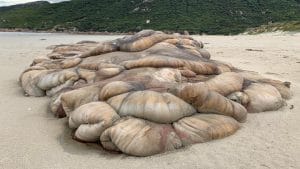
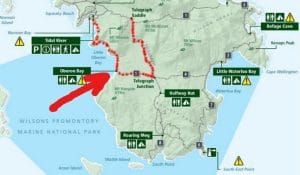
A large piece of whale blubber or possibly even a whale placenta has washed up on the beach at Oberon Bay in the past few days.


Field Research Officer David Donnelly of the Dolphin Research Institute, based at Hastings, is gearing up for a big whale season on the Victorian south-east coast.
And, while the peak whale migration season runs between May and November each year, these majestic creatures, including the mighty Blue Whale, can be spotted from a number of Gippsland vantage points, especially along the Bass Coast and around Wilsons Promontory.
In fact, a large piece of whale blubber or possibly even a whale placenta has washed up on the beach at Oberon Bay in the past few days.
However, to date, no one knows exactly what the large lump of biological matter represents.
Mr Donnelly was interviewed on ABC Gippsland Radio on Saturday morning, April 30, about what it might be.
“I wish I could explain what this big blob is,” Mr Donnelly said, noting that it would only be after tissue samples were taken and analysed before they would know for sure.
“Parks Victoria is looking after it,” he said, but being in a remote location, there have only been a few photos of the “thing”.
“Mystery surrounds this thing on the beach and it's not uncommon around the world, big ocean blobs float onto coastlines fairly frequently and quite often they're not understood or are not identified.
“In this case, the first few photos that we've been able to have a look at suggests that it is biological matter.
“So, we're going to rule out all the other things that we’ve had suggested.
“What we're coming back to now is that it’s biological and if it's biological, it must belong to something biological. And in this case, it must be something quite large.
“So, what do we think about then? We think, well, what's in the ocean that’s large and it comes down to more or less whales.
“So what we're thinking along the lines of now, is that possibly a whale has either, one, a whale has become deceased at sea and parts of it are washing ashore, or, two, a placenta from a birth of a large whale may have washed ashore.
“So, they're the two sort of things we're contemplating at the moment, but I must stress we are speculating only, we've not set foot on the beach, not touched or examined what it is this thing is down there at the moment.”
He said the Dolphin Research Institute, based at Hastings, did interact with a lot of agencies, recording whale strandings and the like and at present, were gearing up for a big whale season where they’re looking for “citizen scientists” to help record whale sightings.
“We do a lot of whale work. In fact, we have a citizen scientist whale program which tracks and identifies whales moving along our coastline throughout the two-bays region of the state, so in southeast Gippsland we've done quite a lot of work on whales there, particularly Blue Whales and Humpback whales.
“So, seasonality plays a part in this as well, you know, and we're starting to see humpback whales showing up on our coast in very few numbers, mind you, but also blue whales are in Bass Strait right now.
“So there some candidates there who may offer some explanation to what's on the beach.”
Mr Donnelly explained that Blue Whales are the largest animal that has ever lived on the face of the earth, growing up to 30 metres long, weighing 150 tonnes and living to upwards of 100 years of age.
“Yes, they are the largest animal to have you ever existed on our planet. The ones that inhabit our waters, in Victoria, are actually Pygmy Blue Whales, and they grow to a mere 24 meters so they're a fair bit smaller, at least compared to the Antarctic Blue Whale, which is down a little bit further south and occasionally in our waters.”
Mr Donnelly acknowledged that the “biological blob” might not be a whale placenta because there were thousands of sea creatures from sharks right down to crabs who would like to get their teeth into something like that.
“Parks Victoria is in charge of that section of the coast and it could be a bit of a disposal exercise if the biological matter didn’t wash back out to sea of its own accord.
“I’m not aware of what the sea conditions are like down there at the moment, it might naturally wash back out to sea or it may require intervention,” he said.
He said the agency was now looking ahead to whale time along our coast.
“We're actually quite busy at the moment. We're working up our common dolphin catalogues for Port Phillip Bay and Western Port and preparing for the whale season at the moment.
“And we're going to be running our citizen science program, which is people on beaches and people on cliffs reporting whale sightings across the coast.
“And as I said, we are extending that out to the south-east Gippsland region for this particular season, particularly the Locksport area and down to Wilson's Promontory. So, if anybody is interested in submitting a whale sighting please do so via our website, https://www.dolphinresearch.org.au/
It’s whale watching time
Jump in the car with your beanie and binoculars and head to the Gippsland coastline, especially Bass Coast and South Gippsland, where whale watching time is upon us.
In late autumn whales travel solo or in small pods of up to five in search of warmer waters, stopping at favourite breeding hot-spots along the way.
And it’s a busy time with people from Melbourne, as well as locals, arriving at Phillip Island and other points along the Bass Coast looking for whales.
The most southerly point of mainland Australia, Wilsons Promontory, and the maritime village of Port Albert are prime locations to spot Humpback and Southern Right Whales during their annual migration.
Further east, whale traffic heading north and south makes the Ninety Mile Beach and Lake Tyers Beach ideal viewing points to see a fluke or two.
You can also follow the ‘Bass Coast Whale Discovery Trail’ which maps out some of the best viewing spots for whales with interpretive signage at each of the below points. And you can keep tabs on the latest sightings on the ‘Phillip Island Whale Sightings’ Map.
Here are a few good locations where you might see a whale:
* Cowes
* Grossard Point (Phillip Island)
* The Nobbies & Summerland
* Pyramid Rock (Phillip Island)
* Cape Woolamai
* Punchbowl (wear a life jacket)
* Kilcunda
* Harmers Haven
* Cape Paterson First Surf
* Eagles Nest
Wilsons Promontory & South Gippsland Coast:
* Sealers Cove (Wilsons Promontory)
* Refuge Cove (Wilsons Promontory)
* Glennie Lookout (Wilsons Promontory)
* Pillar Point (Wilsons Promontory)
* Cape Liptrap Lighthouse
* Ned Neale’s Lookout (Sandy Point)
Two of the great ways to get out on the water and watch the whales are with Pennicott Wilderness Cruises, taking visitors out on a 2.5 hour boat cruise from Tidal River and Wildlife Coast Cruises.
The Wilsons Prom Whale Cruise runs for six hours, departing from Port Welshpool Jetty during the spring migration (for tour dates, check their website). They also take whale watching cruises from San Remo.
Australian Tourism award-winning Pennicott Wilderness Journeys offers a 2.5-hour Wilsons Promontory Cruise departing from Tidal River, Wilsons Promontory National Park, that takes you around the rugged coastline, hard-to-access beaches and remote islands.
Even though it's not specifically a whale watching cruise, sightings of these magnificent creatures are very common in season.
No guarantees but at the right time of the year, there’s a very good chance you’ll see a whale from a good clifftop vantage point or by taking one of these well-regarded tours.
Happy whale watching.