

Leongatha has its say on offshore turbines
THE OPPORTUNITY to learn more about prospective offshore wind turbines in their region drew community members to Leongatha’s council chambers on Thursday. While it wasn’t a large turnout, those present were highly engaged, spoke at length and...


THE OPPORTUNITY to learn more about prospective offshore wind turbines in their region drew community members to Leongatha’s council chambers on Thursday.
While it wasn’t a large turnout, those present were highly engaged, spoke at length and were keen to obtain answers to their questions.
There was a mix of enthusiasm for locally generated renewable energy and concerns about the visual impact of future turbines.
As well as chatting, people attached their thoughts to a board, in the form of sticky notes.
“Finally something tangible to create green energy and fight climate change,” one note said.
Others expressed the need for a cautious approach.
“Environmental protection measures need to be in place and respected,” one commenter wrote.
Another note raised more specific concerns, highlighting the need to protect birds in a RAMSAR area and biodiversity in Bass Strait.
One mentioned the need to consider potential impacts on both commercial and recreational fishing.
Cr Sarah Gilligan has heard many concerns from her local community in Venus Bay about the prospect of wind turbines being installed in the area, and attended the ‘drop in’ session to learn more.
She was pleased with what she heard, learning that any licences to be allocated at the next stage will be ‘feasibility licences’.
She said companies granted such licences will need to conduct feasibility and environmental studies, and community consultation, and looks forward to updating her community.
“It’s exciting but needs due diligence,” Cr Gilligan said of the prospect of future renewable energy projects in the region.
Currently part of the identified area for potential offshore energy production sits just three nautical miles off the Venus Bay coast, with that representing the start of Commonwealth waters.
While councillors will soon be briefed on the subject of offshore renewables, Cr Gilligan intends to make a personal submission.
Submissions will be included in a report to be presented to the relevant Minister to help inform their decision on how to proceed.
The Department of Climate Change, Energy, Environment and Water (DCCEEW) is responsible for running public consultation on the area under consideration, with people encouraged to make submissions prior to the October 7 cut-off.
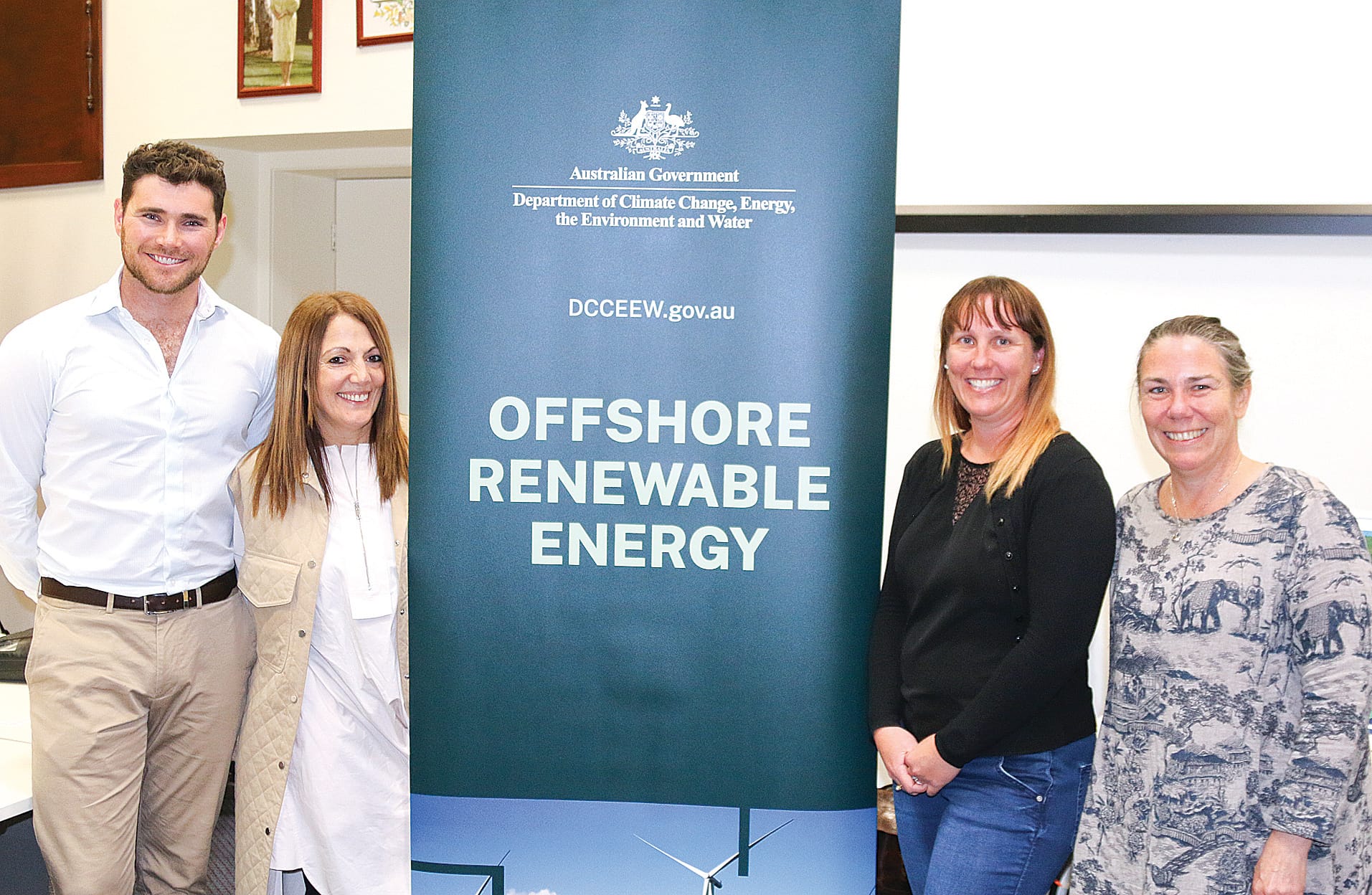
Official submissions are the way to make your voice heard, with drop-in sessions in Yarram, Leongatha, and Wonthaggi designed for people to ask questions.
Belinda Nicholls of Korumburra believes renewable energy is the way of the future and was interested to learn that other projects, such as solar initiatives may also be considered along with turbines.
“I came to find out why the area was chosen, what the benefits are and to discover more about what the potential projects would be,” she said.
She was advised there may be height limitations on turbines.
“It’s good to know what feedback to provide,” she said.
Having a role at a community house, Belinda sees the impact of high energy costs and considers there is a place for state run energy infrastructure.
However, current government focus is directed at providing the required level of assistance to help privately operated renewable energy infrastructure become commercially viable.
Another attendee expressed qualified support.
“I think turbines are a good idea; however, I’m concerned about the visual impact on the seascape,” the Walkerville resident said, indicating he’d like them to be installed further out to sea than the proposed minimum of three nautical miles.
Leongatha’s Helen Barrow is reserving judgement at this early stage, saying there are lots of things that need to be considered, while expressing concern as to whether sufficient thought has gone into the race towards renewable energy.
Judy Stokes of Hedley expressed interest in learning about the prospect of storing renewable energy generated by future projects, using batteries.
Such details are uncertain at this stage with much depending on the ideas of proponents and the suitability of their proposals.
Members of the DCCEEW implementation team will look at the area that has been identified, assess community feedback and identify ways of accommodating concerns, preparing a report for the Minister.
The Department of Environment, Land, Water and Planning (DELWP) was among the organisations helping run the drop in sessions.
Its energy markets manager, James Golden, said that government assistance will initially be required to make offshore renewable energy production financially viable.
That is largely because of the substantial initial infrastructure costs and the need to obtain the kind of vessels required, to enable construction of wind turbines at sea.


